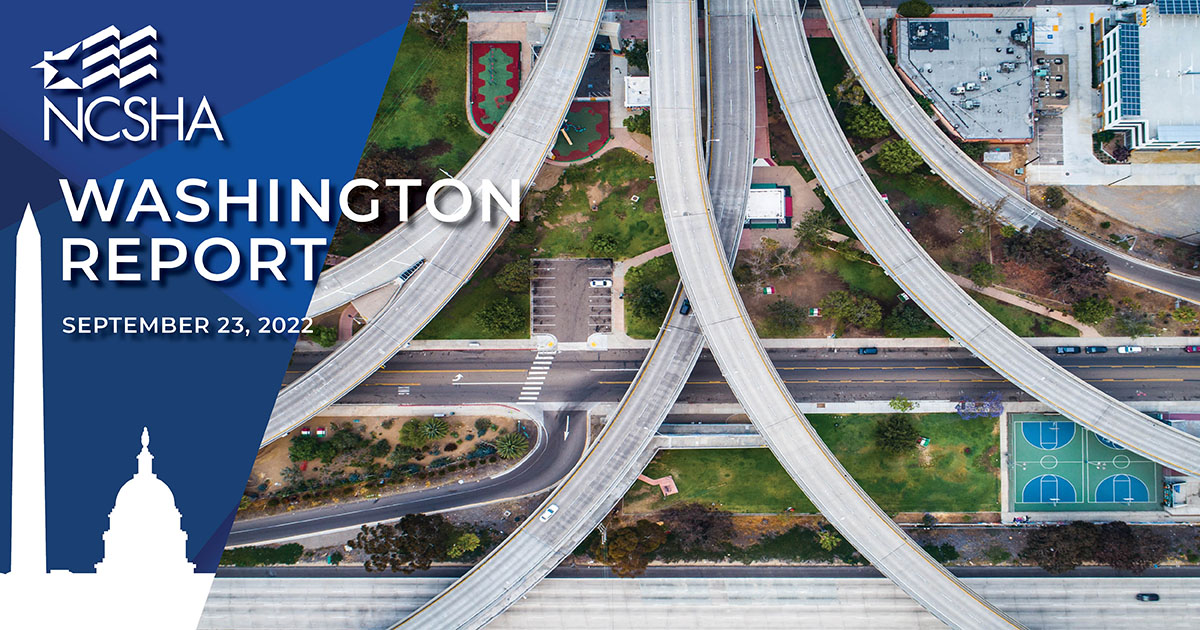
NCSHA Washington Report | September 23, 2022
We try to stay in our lane here at Washington Report, which is plenty wide, with housing affordability and supply among the central social and economic challenges facing our country and state HFAs increasingly central to solving them.
So our initial assessment of the big infrastructure bill that passed 10 months ago focused mainly on its huge expansion of the federal home weatherization program and the opportunities it presents for the 16 HFAs that administer it.
Now, with the help of UpLook Advisors and its founder Laurel Blatchford, we’re starting to see, and hoping to illuminate for others, a number of other areas in the Bipartisan Infrastructure Law with potentially significant implications for housing.
For example, the bill makes what the White House calls “the largest Federal Investment in public transit in the nation’s history,” aiming at the household expense second only to — and often inextricably linked to — housing cost. The Department of Transportation is already reviewing applications for new transit-oriented development projects, which HUD research has shown depend greatly on Housing Credits for affordability.
The bill also includes “a first-of-its-kind comprehensive investment in broadband deployment, equity, and affordability,” according to the Brookings Institution, through $65 billion in several programs administered by the Federal Communications Commission (FCC) and National Telecommunications and Information Administration. The Uplook Advisors’ analysis highlights an FCC pilot program to help recipients of federal housing assistance access discounted internet service and technology. HUD recently announced that subsidy from the program doesn’t count as income for determining family rent or impact eligibility for HUD assistance.
The infrastructure bill also appropriated $55 billion to modernize the country’s water and wastewater systems, which currently leave roughly 10 million households without safe drinking water, according to McKinsey and Company. In addition to the obvious health and equity benefits, this investment may reduce pressure on home builders to pay impact fees, which end up increasing home prices.
There are also 25 competitive grant programs available to state and local governments in the bill. One example is a new $1 billion program through the Department of Transportation that will fund local efforts to reknit neighborhoods torn apart by highways and similar projects. Another is a new $1 billion initiative run by the Commerce Department for the construction and improvement of “middle mile” broadband infrastructure in underserved areas.
Over time, projects funded by these and other programs may increase nearby property values, create opportunities for new development, and attract additional investment — all dynamics with potential positives and negatives for housing affordability that demand close community-level attention.
Of course, inflation has taken a bite out of the infrastructure bill’s purchasing power already, and many projects will face the same supply chain disruptions and labor shortages that are hammering the housing industry. Nevertheless, the Biden–Harris Administration says more than 5,300 projects are underway, and many thousands more will come on line in the months and years ahead.
Heads up, housers.

Stockton Williams | Executive Director
State HFA Emergency Housing Assistance
In This Issue
- NCSHA Releases Analysis of Rental Housing Production Threat from Escalating Costs, HFA Strategies for Mitigating Impact
- HUD Allocates New Housing Choice Vouchers to Almost 2,000 PHAs, 21 State HFAs
- HUD Provides $180 Million in Choice Neighborhood Grants to Four Cities
- Senate Banking Subcommittee Hears Stakeholders on USDA’s Rural Housing Programs
- HUD Releases Preview of Green and Resilient Retrofit Program RFI
- CFPB Publishes RFI on Refinances and Forbearances
- NCSHA in the News
- Looking Ahead
NCSHA Releases Analysis of Rental Housing Production Threat from Escalating Costs, HFA Strategies for Mitigating Impact
This week, NCSHA released an independent report by social policy research firm Abt Associates analyzing the unprecedented challenges facing state HFAs and their affordable housing development partners due to the rapidly rising costs of labor, materials, and financing and how this is putting Housing Credit development at risk.
The study is based on interviews with 11 state HFAs and 11 other Housing Credit industry practitioners — developers, accountants, and attorneys — about the financing obstacles they have faced since the beginning of the COVID-19 pandemic. The report finds that nearly all deals awarded Housing Credits since 2019 have faced significant, unexpected cost increases. The resulting financing gaps average approximately 30 percent of total development costs.
Options available to state HFAs and their partners for filling these gaps depend on what resources they have, with some state agencies and developers better resourced and equipped to move quickly to fill the gaps than others. Shoring up the projects facing gaps comes at a cost to current and future production. While many states are making use of Coronavirus State and Local Fiscal Recovery Fund resources to fill financing gaps, not all state HFAs received this resource from their state governments, and the demand for gap filler across the board is substantial, underscoring the need for more federal resources. NCSHA continues to press Congress to provide increased funding for the HOME program and to expand Housing Credit resources through a cap increase and by lowering the bond financing threshold.
HUD Allocates New Housing Choice Vouchers to Almost 2,000 PHAs, 21 State HFAs
The Department of Housing and Urban Development announced today the awarding of approximately 19,400 new Housing Choice Vouchers to 1,945 public housing agencies across the country, including 21 state HFAs. HUD says this is the most expansive allocation of flexible new rental assistance in 20 years, with vouchers going to nearly every community in the country, and some communities receiving their first allocation in decades. The total amount HUD awarded is $214,519,250. The list of awards is available here.
HUD Provides $180 Million in Choice Neighborhood Grants to Four Cities
On Monday, HUD announced four communities will share $180 million in grants to revitalize public housing. This year’s recipients of the department’s Choice Neighborhood Implementation Grants are Tulsa, Oklahoma ($50 million); Omaha, Nebraska ($50 million); Knoxville, Tennessee ($40 million); and Durham, North Carolina ($40 million). The grants will help the recipients replace distressed HUD-assisted housing with mixed-income housing and attract additional investments from local partners to supplement the federal assistance. This year’s awardees will leverage an additional $2.5 billion in public and private resources for their communities.
Senate Banking Subcommittee Hears Stakeholders on USDA’s Rural Housing Programs
On Wednesday, the Senate Banking Subcommittee on Housing, Transportation, and Community Development heard from stakeholders on the Rural Housing Service’s affordable housing programs. Participating as a non-committee member guest, Senator Jeanne Shaheen (D-NH) referenced a survey conducted by the New Hampshire Housing Finance Authority comparing the state’s affordable housing vacancy rates with vacancy rates around the country and underscored the important role USDA rural housing programs play in serving rural communities.
Subcommittee Chair Tina Smith (D-MN) and Shaheen discussed a bill they introduced last week allowing USDA to “decouple” rental assistance from mortgages on USDA Section 515 multifamily properties, keeping covered units affordable after a property’s mortgage matures or is paid off. Hearing witnesses testified about the importance of Section 515 properties to the affordable housing stock in rural areas, especially in the Mid-West, where Section 515 mortgages are set to mature earlier than in other parts of the country. The recording of the hearing is available here.
HUD Releases Preview of Green and Resilient Retrofit Program RFI
On September 22, HUD released a preview version of a Request for Information it will publish officially in the Federal Register next week requesting comments on its new Green and Resilient Retrofit Program (GRRP). HUD is establishing the GRRP pursuant to a section of the Inflation Reduction Act providing $1 billion to HUD for energy and water efficiency retrofits and climate resilience of HUD-assisted multifamily properties. Send Garth Rieman by October 12 feedback for NCSHA to consider in its comments on the RFI.
CFPB Publishes RFI on Refinances and Forbearances
On September 22, the Consumer Financial Protection Bureau (CFPB) released a Request for Information seeking comment about ways to facilitate mortgage refinances for consumers who would benefit from them, especially consumers with smaller loan balances, and to reduce risks for homeowners who experience disruptions in their financial situation that could interfere with their ability to remain current on their mortgage payments. Comments will be due within 60 days of publication in the Federal Register, which has not yet occurred.
NCSHA in the News
Notes from Novogradac, 9.22.22, Novogradac LIHTC Working Group Comments on NCSHA’s Recommended Practices
Novogradac News and Analysis, 9.20.22, NCSHA Report: Affordable Housing Properties Seeing Unexpected Cost Jumps of 30%
The Carlisle Sentinel, 9.19.22, Guest Editorial: Steps in alleviating the housing crisis
Legislative and Regulatory Activities
- September 26 | Comments Due | Ginnie Mae/FHA Request for Input on Title I Manufactured Housing Programs
- September 28 – 29, October 4 | FHFA Listening Sessions on FHFA Review of Federal Home Loan Bank System
Greg Zagorski will speak at this event. - September 28 | Comments Due | HUD’s Draft Solicitation on Housing Assistance Payments Contract Support Services (HAPSS)
- October 7 | Comments Due to NCSHA | FHFA Proposed Affordable Multifamily Housing Goals for Fannie Mae and Freddie Mac
- October 10 | Comments Due to NCSHA | FHFA Review of Federal Home Loan Bank System
- October 12 | Comments Due to NCSHA | HUD RFI on Green and Resilient Retrofit Program
- October 17 | Comments Due | FHFA Proposed Affordable Multifamily Housing Goals for Fannie Mae and Freddie Mac
- October 20 │ Applications Due │ HUD Continuum of Care Program Supplemental Funding Opportunity to Address Unsheltered and Rural Homelessness
- October 21 | Comments Due | FHFA Review of Federal Home Loan Bank System
- TBD circa October 29 | Comments Due to NCSHA | HUD RFI on Green and Resilient Retrofit Program
NCSHA, State HFA, and Industry Events
- September 27 – 29 | Oklahoma Housing Conference | Oklahoma City, OK
Stockton Williams will speak at this event. - September 28 – 29 | 2022 Wisconsin Housing and Economic Development Authority Conference | Madison, WI
Garth Rieman will speak at this event. - September 29 – 30 | Novogradac 2022 Affordable Housing Tax Credit and Bonds Conference | Nashville, TN
Jennifer Schwartz will speak at this event. - October 18 | Ohio Housing Council Fall Symposium | Columbus, OH
Jennifer Schwartz will speak at this event. - October 19 – 21 | Affordable Housing Investors Council 2022 Affordable Housing Summit | Minneapolis, MN
James Tassos will speak at this event. - October 22 – 25 | NCSHA Annual Conference & Showplace | Houston, TX
- October 25 – 28 | National Affordable Housing Management Association Fall Conference | Washington, DC
Jennifer Schwartz will speak at this event. - November 9 – 10 | ProLink Technology Live 2022 | Virtual
Jennifer Schwartz will speak at this event. - November 15 | New Hampshire Housing’s Housing & Economy Conference | Manchester, NH
Jennifer Schwartz will speak at this event. - November 16 | 2022 Vermont Statewide Housing Conference | Burlington, VT
Jennifer Schwartz will speak at this event.
Back to NCSHA Washington Report
Only members receive NCSHA Blog and Washington Report.