NCSHA Washington Report | November 12, 2021
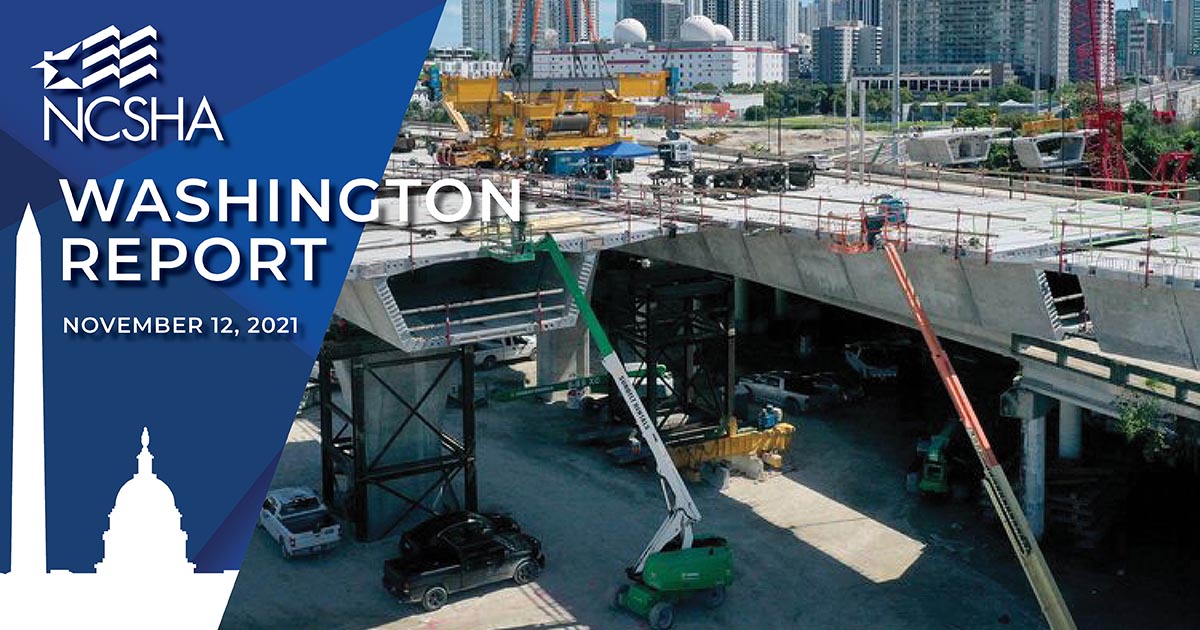
While the short-term economic effects of the $1 trillion infrastructure bill President Biden plans to sign Monday are a subject of debate, most analysts expect the Infrastructure Investment and Jobs Act will be good for growth and jobs in the years to come. Two provisions caught our eye for their direct connections to the mission of state HFAs.
The bill puts $3.5 billion into the Weatherization Assistance Program, which should help 700,000 low-income households make cost-cutting, health-improving energy upgrades to their homes, according to the U.S. Department of Energy. More than half the state HFAs deliver federal weatherization, energy efficiency, or home energy assistance resources.
For an illustration of the impacts, take a look at what the New Mexico Mortgage Finance Authority has accomplished for its state over the past decade: more than 10,300 fully-weatherized homes, averaging 27 percent in energy savings, plus “58,000 gallons of water saved every day due to the installation of low-flow devices in weatherized homes.”
Weatherization is among the most “hammer-ready” investments the bill makes. Some of the home improvements should come in time to blunt surges in energy bills this winter that could exceed 50 percent for homes that depend on natural gas and heating oil and 90 percent for those that rely on propane, according to the U.S. Energy Information Administration. (HFAs also will help thousands of low-income families pay those higher bills through their Emergency Rental Assistance and Homeowner Assistance Fund programs.)
The infrastructure bill also provides $65 billion to expand broadband internet infrastructure, affordability, and access. The latter two areas, along with targeted funding for state and local “digital inclusion” efforts, reflect an evolving understanding of the digital divide, which “has shifted over the years and is now more about affordability, data show,” according to Bloomberg Government.
The bill “lets state officials take the lead in deciding how the funds are spent, with each state’s plan approved by the Commerce Department,” the Wall Street Journal reports. “That is a departure from previous programs run largely at the federal level.”
State HFAs are already in the mix. Rhode Island Housing offers incentives to local governments and nonprofit groups for “innovative and long-term sustainable projects to increase internet access for low- and moderate-income households across the state.” Ohio HFA requires broadband infrastructure and access in its new annual Housing Credit plan. Ten other states have adopted similar approaches “by mandating or incentivizing higher speeds, paying for tenants’ coverage, or providing device-lending programs,” according to a report from Stewards of Affordable Housing for the Future.
Getting a bipartisan infrastructure bill done is a big deal, but “now the action shifts,” write analysts from the Brookings Institution. While federal agencies have “enormous responsibility to implement the law… [s]tate and local officials carry an even greater burden. As the owners and operators of most infrastructure, they must design and build new assets, hire more workers, and even mobilize their own financial resources.”
All potholes, like most politics, are local.

Stockton Williams | Executive Director
State HFA Emergency Housing Assistance
In This Issue
- Altoro Joins Biden Administration as USDA Rural Housing Service Administrator
- NCSHB Elects New Board Officers, Directors
- IRS Releases Tax Guidance on HAF Assistance
- IRS Releases 2022 Housing Credit and Private Activity Bond Volume Cap Amounts
- CDFA Report Finds PAB Issuance at Record Highs for 2019 and 2020; Housing Bond Issuance Increases
- Novogradac Estimates Build Back Better Act Would Add Nearly One Million Affordable Homes Through Housing Credit Enhancements, Establishment of Neighborhood Homes Credit
- HUD Develops Resource for Organizations Interested in Becoming Approved Housing Counseling Agencies
- NCSHA in the News
- Looking Ahead
- Altoro Joins Biden Administration as USDA Rural Housing Service Administrator
Altoro Joins Biden Administration as USDA Rural Housing Service Administrator
The U.S. Department of Agriculture (USDA) on Monday announced WHEDA executive director and NCSHA Board Secretary/Treasurer Joaquín Altoro has been appointed administrator of the Rural Housing Service (RHS). He replaces Chad Parker, who has led RHS as acting administrator since January 2021. Under Altoro’s leadership, the Wisconsin Housing and Economic Development Authority continued to advance its affordable housing and community development services and developed new initiatives to promote increased equity and better serve historically marginalized communities within Wisconsin. NCSHA congratulates Mr. Altoro on his new role and looks forward to continuing to work with him to create an affordably housed nation.
NCSHB Elects New Board Officers, Directors
On Thursday, the National Conference of State Housing Boards elected the following HFA board members to its 2021 – 22 Board of Directors:
- President: Paul Kennedy | North Carolina Housing Finance Agency
- First Vice President: Alishia Topper | Washington State Housing Finance Commission
- Second Vice President: Mark Schwartz | Pennsylvania Housing Finance Agency
- Director: Sonia Berg | Illinois Housing Development Authority
- Director: Michael Martin | Wyoming Community Development Authority
IRS Releases Tax Guidance on HAF Assistance
The Internal Revenue Service on Monday released Revenue Procedure 2021-47 stating that Homeowner Assistance Fund (HAF) payments made to homeowners qualify as disaster relief and are not included in the homeowners’ gross income for federal tax purposes. Consequently, beneficiaries will not have to pay taxes on HAF payments. Furthermore, HAF administrators are not required to provide Form 1099-MISC to HAF recipients. NCSHA has been advocating for Treasury to clarify that HAF assistance is not taxable income since the program first became law earlier this year. The revenue procedure also outlines HAF administrators’ reporting requirements for any payments made directly to third parties on behalf of beneficiaries. The revenue procedure takes effect immediately and applies to all HAF payments made to or on behalf of homeowners after January 21, 2020.
IRS Releases 2022 Housing Credit and Private Activity Bond Volume Cap Amounts
On November 10, IRS published Revenue Procedure 2021-45, which outlines the inflation adjustments for more than 60 federal tax provisions, including the amount of Housing Credit and Private Activity Bond (PAB) authority each state will receive next year. Unless Congress passes legislation — such as the Build Back Better Act — that increases the Housing Credit cap, the state Housing Credit ceiling will be the greater of $2.60 multiplied by the state population or $2,975,000. This would be a reduction of approximately 7.5 percent from the 2021 per capita amount ($2.8125) and 8.3 percent from the 2021 small-state minimum ($3,245,625), due to the expiration of the temporary 12.5 percent cap increase put in place in 2018.
The Housing Credit ceiling amount is subject to change if the cap increase provision in the Build Back Better Act moves forward. The state PAB cap multiplier for 2022 would remain $110 multiplied by the state population, the same as 2021. The PAB small-state minimum, however, would increase from $324,995,000 in 2021 to $335,115,000 in 2022. The revenue procedure also sets the Housing Credit minimum rehabilitation expenditure at $7,400 per unit in 2022 compared to $7,100 in 2021.
CDFA Report Finds PAB Issuance at Record Highs for 2019 and 2020; Housing Bond Issuance Increases
Private activity bond issuance reached record-high levels in 2019 before declining slightly in 2020, according to the Council of Development Finance Agencies’ Annual Volume Cap Report for 2019 and 2020. The report, released late last week, presents data on how states allocate and use their PAB cap each year, with this year’s report covering both 2019 and 2020. According to the report, total PAB issuance in 2019 was $30.5 billion, up more than 20 percent from $25.3 billion in 2018. This is the highest level of PAB issuance recorded since CDFA starting tracking in 2005. PAB issuance decreased in 2020 to $27.7 billion, the second-highest level on record.
Housing Bonds again accounted for the overwhelming share of PAB activity in both years. The report finds that state and local governments issued nearly $25.9 billion in Housing Bonds in 2019, up more than 10 percent from $23.2 billion in 2018. Housing Bond issuance declined slightly in 2020 to $24.3 billion. Housing Bonds accounted for 84 percent of total PAB issuance in 2019 and 88 percent in 2020. NCSHA summarized the report in more detail in our blog.
Novogradac Estimates Build Back Better Act Would Add Nearly One Million Affordable Homes Through Housing Credit Enhancements, Establishment of Neighborhood Homes Credit
Earlier this week, Novogradac released an analysis of provisions in the Build Back Better Act, which the House Rules Committee released November 3, estimating that the Housing Credit provisions would create 811,900 affordable rental homes from 2022 – 31. The analysis estimates the creation of an additional 125,000 affordable owner-occupied homes as a result of the Neighborhood Homes Credit, for a total of 936,900 homes overall. Based on research from the National Association of Home Builders, Novogradac estimates that the 811,900 additional rental homes financed with the Housing Credit could house nearly 1.9 million low-income people and generate more than 1.2 million jobs, more than $137 billion in wages and business income, and more than $47 billion in tax revenue over a decade.
HUD Develops Resource for Organizations Interested in Becoming Approved Housing Counseling Agencies
HUD’s Office of Housing Counseling (OHC), in a partnership with ICF, has created an online educational course for organizations considering becoming HUD-approved housing counseling agencies. The Learning Pathway is intended to teach organizations about the process and qualification requirements for applying to become a HUD-approved housing counseling agency. OHC has made nearly 11 hours of content available, ranging from the benefits of housing counseling to understanding housing counseling client management systems. More information about the Learning Pathway is available here.
NCSHA in the News
Bond Buyer, 11.11.21, Housing provision in reconciliation bill eases private activity bond cap
Notes from Novogradac, 11.9.21, More Than $12 Billion in LIHTC Provisions and Nearly $6 Billion for Neighborhood Homes Tax Credits in Nov. 3 Draft of the Build Back Better Reconciliation Bill Would Finance Close to 1 Million Affordable Homes Over 2022–31
Notes from Novogradac, 11.9.21, Revised $1.75 Trillion Build Back Better Reconciliation Legislation Includes $325 Billion in Green Tax Incentives, More Than $156 Billion in Housing and Community Development Spending, and More Than $18 Billion in LIHTC, NHTC Proposals
Notes from Novogradac, 11.5.21, Despite Pandemic Concerns, Multifamily Private Activity Bond Issuance Reaches New Record of $17.2 Billion in 2020
Legislative and Regulatory Activities
- November 16 | Application Deadline | FR-6500-N-25, Notice of Funding Opportunity FY 2021 Continuum of Care Competition
NCSHA, State HFA, and Industry Events
- November 17 – 18 | NCSHA’s Housing Credit 101 | Virtual
- November 18 – 19 | National Association of Home Builders Mortgage Roundtable | New York City
Stockton Williams will participate in this event. - December 1 – 2 | 2021 Virtual Ohio Housing Conference
Stockton Williams will speak at this event. - December 1 – 3 | Novogradac 2021 Tax Credit Housing Finance Conference | Las Vegas
Jennifer Schwartz will speak at this event.
Back to NCSHA Washington Report
Only members receive NCSHA Blog and Washington Report.