NCSHA Washington Report | January 7, 2022
State housing finance agencies, always the vanguard of financing for affordable homeownership opportunities and rental apartment properties for low-income people, also will be busy this year helping many Americans stay safely housed.
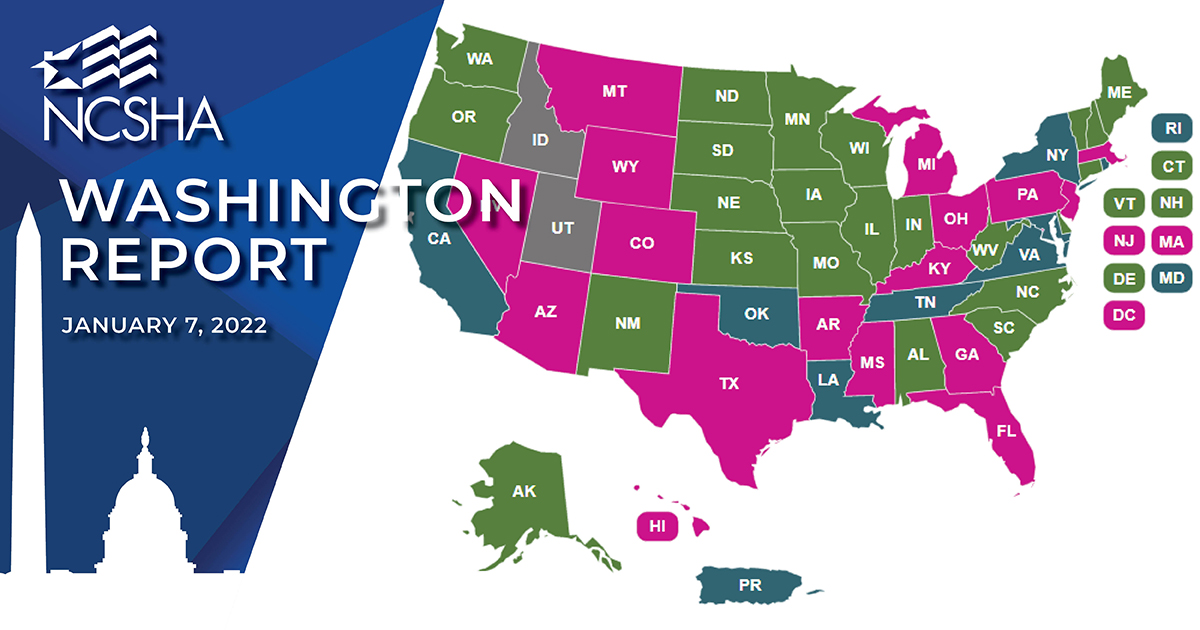
The HFAs in 40 states, Puerto Rico, and the Virgin Islands are administering the Homeowner Assistance Fund, a $10 billion program to help economically vulnerable homeowners avoid mortgage delinquencies and defaults, utility cutoffs, foreclosures, and displacement.
The Treasury Department started approving states’ and territories’ plans for using their shares of the funding late last fall, with approvals accelerating at the end of last year. California, Louisiana, New York, Maryland, and Virginia opened their programs in the last week or so.
Announcing the opening of her state’s program this week, New York State Homes and Community Renewal Commissioner RuthAnne Visnauskas said, “Working with our partners in legal services and community-based housing organizations, we have designed the Homeowner Assistance Fund program to help our at-risk families in every corner of the state regain financial stability.”
Twenty-eight state HFAs are involved in delivering federal Emergency Rental Assistance. With almost all the $25 billion from the first congressional appropriation spent (by states and hundreds of local programs) last year, the main focus will be the second $21.5 billion appropriated last March. State HFAs will run about 30 percent of it.
A number of states also are working with Treasury to better match funding with needs on the ground by supporting their local jurisdictions that have exhausted their own direct allocations of funds from the first ERA appropriation. Today, Treasury announced that 12 states moved more than $860 million to city, county, and tribal programs in their states. This kind of intergovernmental cooperation probably isn’t clickbait. It’s simply effective administration of taxpayers’ money that aligns scarce resources with actual demand.
In 39 states, Puerto Rico, and the Virgin Islands, HFAs are entrusted with meeting the urgent needs of people experiencing or on the brink of homelessness with the $5 billion emergency HOME-ARP program. States, along with hundreds of local jurisdictions, are now developing plans for HUD’s approval, using program funds the department disbursed early to help accelerate the process.
Among the state officials who see the potential is Colorado Governor Jared Polis, who said, “These funds from the American Rescue Plan will offer direct, immediate results and pave the way for long-term solutions to end homelessness.”
HFAs have been housing emergency responders for decades, usually in the wake of severe storms. The efforts of the Kentucky Housing Corporation to help its state recover from one of the worst natural disasters in its history a few weeks ago is just the latest example.
The pandemic forced state HFAs to evolve in response to a new kind of disaster, to stretch existing capacities and build new ones. It has been a challenge unlike any they have been asked to take on. Growing pains largely behind them, the agencies are poised to deliver housing relief to those who need it most as never before in 2022.

Stockton Williams | Executive Director
State HFA Emergency Housing Assistance
In This Issue
- White House, Congressional Democrats Take Hiatus from Build Back Better Talks
- Treasury Issues Final Rule for Fiscal Recovery Fund Program
- Treasury Begins Emergency Rental Assistance Reallocation Process; 665,000 Households Assisted in November
- States Opening HAF Programs as Treasury Approves More Plans
- FHFA Establishes New, Higher Affordable Housing Goals for Fannie Mae, Freddie Mac
- FHFA Finds GSEs Mostly Met Affordable Housing Goals in 2020
- FHFA Tells GSEs to Consider Climate Change
- FHFA Issues Proposal Requiring Annual Capital Plans from Fannie, Freddie
- NCSHA in the News
- Looking Ahead
White House, Congressional Democrats Take Hiatus from Build Back Better Talks
Since Senator Joe Manchin (D-WV) announced last month that he would not support the Build Back Better legislation without significant modifications, Senate Democrats have pivoted to work on voter rights legislation. However, negotiations on Build Back Better — the reconciliation bill central to President Biden’s domestic agenda — are expected to restart soon with the goal of reworking the package into something all 50 Senate Democrats can support. Manchin is expected to seek to focus the legislation on certain key areas, including climate-related issues, with policies lasting for the bill’s full 10-year term rather than shorter time periods, as he believes this more accurately reflects the true cost of provisions in the bill given expectations that Democrats would seek to extend provisions upon their expiration anyway. NCSHA will be continuing our advocacy to retain HFA affordable housing priorities in the next iteration of the bill, including investments in the Housing Credit, down payment assistance, the HOME program, and other important initiatives.
Treasury Issues Final Rule for Fiscal Recovery Fund Program
On January 6, the U.S. Department of the Treasury issued the final rule for the American Rescue Plan State and Local Fiscal Recovery Funds (SLFRF) program, which provided $350 billion to state, local, and tribal governments to support their responses to and recovery from the COVID-19 pandemic. The final rule responds to a concern NCSHA and others raised about the interim rule by expanding eligibility for where recipients can use SLFRF for affordable housing development without further analysis and justification. The final rule does this by changing the definition of impacted households and communities to include low- or moderate-income households and communities, households that experienced unemployment, and households that qualify for the National Housing Trust Fund and HOME Investment Partnerships program. Additionally, the final rule states, “Treasury will presume that any projects that would be eligible for funding under either the National Housing Trust Fund (HTF) or the Home Investment Partnerships Program (HOME) are eligible uses of SLFRF funds.”
The final rule makes other changes to the interim rule, including allowing SLFRF funds to be used for down payment assistance, but does not solve the problem NCSHA and others identified regarding using FRF funds for Housing Credit properties. The final rule takes effect on April 1. Treasury has published an overview of the final rule’s major provisions.
Treasury Begins Emergency Rental Assistance Reallocation Process; 665,000 Households Assisted in November
Today, Treasury released new data on the first round of reallocation of Emergency Rental Assistance authorized under the Consolidated Appropriations Act of 2021 (ERA 1). The reallocation process, required by the statute, gives Treasury the opportunity to “right-size” grantees’ grant amounts to better reflect need on the ground given the inconsistencies between the program’s formula and rental needs in practice. Of the $1.1 billion reallocated, more than three quarters was transferred voluntarily between grantees in the same state.
Four states — California, New Jersey, New York, and Oregon — and the District of Columbia received additional funds as part of the reallocation. The remaining reallocated funds went to localities and tribes. Moreover, 12 states were able to voluntarily transfer more than $860 million to local governments and tribes in their states. In general, state grantees report receiving far less than what they requested from Treasury. However, this is because the need for rental assistance nationwide far exceeds the funds available. Many states that requested assistance did not receive any in this first reallocation, as very little of the reallocated funds went to grantees in states where other grantees did not have funding recaptured.
Treasury also released the November ERA spending data, showing that November was a record month for provision of ERA assistance, with nearly $2.9 billion in expenditures from both ERA 1 and ERA 2 (funding appropriated in the American Rescue Plan) and 665,000 households assisted.
States Opening HAF Programs as Treasury Approves More Plans
The Treasury Department continues to approve state Homeowner Assistance Fund plans, with 23 approved to date. The states and territories with approved plans are Alabama, Alaska, Arizona, California, Hawaii, Illinois, Iowa, Kentucky, Louisiana, Maine, Maryland, Michigan, New Jersey, New York, North Carolina, Ohio, Oklahoma, Pennsylvania, Puerto Rico, Rhode Island, Tennessee, Virginia, and Wyoming. Five states and Puerto Rico have opened their programs on a whole-state basis, with more scheduled to open Monday, January 10. For the most up-to-date information about HAF program openings or to reach state program websites, visit NCSHA’s map.
FHFA Establishes New, Higher Affordable Housing Goals for Fannie Mae, Freddie Mac
The Federal Housing Finance Agency (FHFA) December 22 published a final rule establishing updated affordable housing goals for Fannie Mae and Freddie Mac. The rule sets higher benchmarks for single-family and multifamily housing goals and subgoals and creates two new single-family subgoals to replace the existing low-income areas subgoal. One new subgoal continues to target low-income neighborhoods; the other targets minority communities. The new single-family goals will apply for years 2022 through 2024, while the multifamily goals apply only for 2022. The final rule largely maintains the affordable housing goals FHFA first proposed in August. NCSHA expressed support for the higher goals in our comments on the proposed rule. Read NCSHA’s detailed summary of the new affordable housing goals.
FHFA Finds GSEs Mostly Met Affordable Housing Goals in 2020
FHFA announced on December 20 its final determination on Fannie Mae’s and Freddie Mac’s performance toward meeting their affordable housing goals for 2020. FHFA found Fannie Mae met all its single-family and multifamily affordable housing goals for that year. Freddie Mac met all its multifamily goals and all but one of its single-family goals: the requirement that at least 21 percent of refinance loans purchased be for low-income homeowners. FHFA has directed Freddie Mac to prepare a housing plan describing how it will improve its performance in this area in 2022–24.
FHFA Tells GSEs to Consider Climate Change
On December 27, FHFA Acting Director Sandra Thompson issued a statement acknowledging the risk climate change poses to the U.S. housing finance system and the leadership role its regulated entities play in addressing the consequences. FHFA has instructed Fannie Mae and Freddie Mac (the Enterprises), and encouraged the Federal Home Loan Bank System, to designate climate change as a priority concern and to actively consider its effects in their decision-making. FHFA also announced its new Conservatorship Scorecard — the mechanism for communicating its priorities and expectations for the Enterprises — includes accountability for ensuring resiliency to climate risks.
FHFA Issues Proposal Requiring Annual Capital Plans from Fannie, Freddie
On December 27, FHFA published a proposed rule to require Fannie Mae and Freddie Mac to submit annual capital plans to FHFA and to provide prior notice for certain capital actions. FHFA also is incorporating the determination of the stress capital buffer into the capital planning process. The proposal is intended, among other things, to establish minimum supervisory standards and processes for the Enterprises and to provide FHFA with an opportunity to review the Enterprises’ planned capital distributions. Comments are due to FHFA on or before February 25.
NCSHA in the News
Community News, 12.24.21, Map Reveals the States Paying ‘Incentive Checks’ for Homeowners
Notes from Novogradac, 12.22.21, Senate Draft of Build Back Better Reconciliation Bill – Currently Stalled by Sen. Manchin – Would Finance Nearly 1 Million Affordable Homes Over 10 Years
The U.S. Sun, 12.22.21, Map reveals the states paying homeowner mortgage ‘stimulus checks’ – with up to $80,000 per household
Legislative and Regulatory Activities
- January 13 | Senate Banking Committee Hearing to Discuss the Nomination of Sandra Thompson to Be Director of the Federal Housing Finance Agency
- February 25 | Comments Due | FHFA Proposed Rule on Fannie Mae and Freddie Mac Annual Capital Plans
NCSHA, State HFA, and Industry Events
- January 10 – 14 & 24 – 28 | NCSHA’s HFA Institute 2022 | Virtual
- January 13 – 14 | Novogradac 2022 Affordable Housing Developers Conference | Virtual
Jennifer Schwartz will speak at this event. - January 26 – 27 | Affordable Housing Tax Credit Coalition 2022 Annual Meeting | Austin, TX
Jennifer Schwartz will speak at this event. - February 2 – 4 | National Community Development Association 2022 Winter Conference | Virtual
Jennifer Schwartz will speak at this event. - March 14 – 16 | NCSHA’s 2022 Legislative Conference | Washington, DC
Back to NCSHA Washington Report
Only members receive NCSHA Blog and Washington Report.