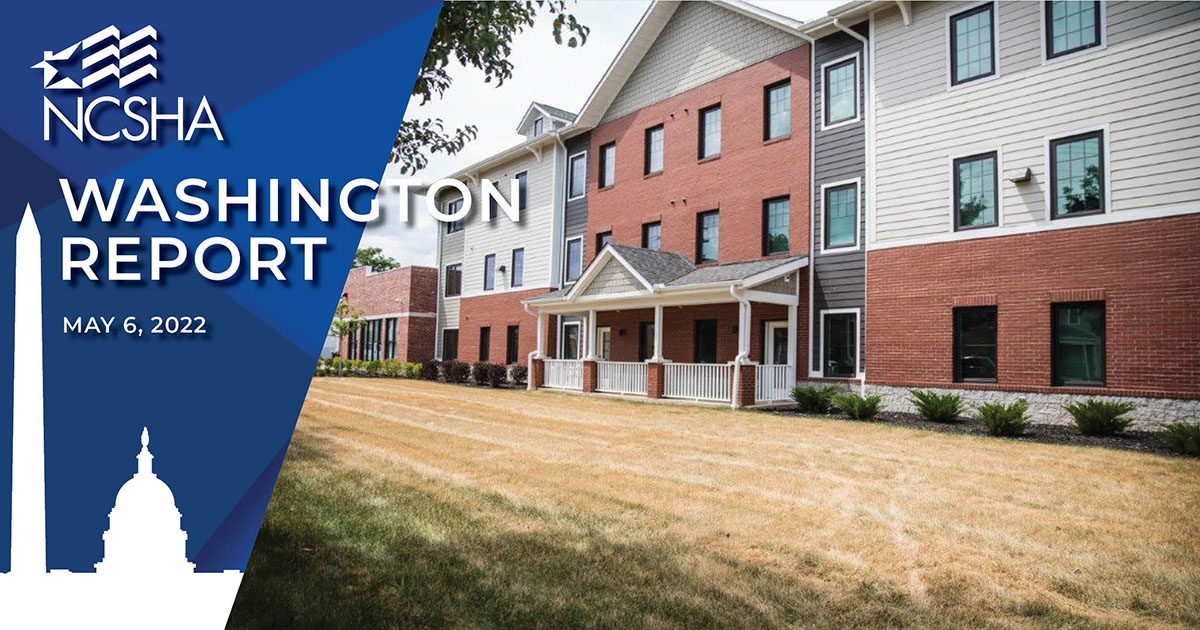
NCSHA Washington Report | May 6, 2022
Even when the administration’s (and our) hopes were higher for the historic housing production investments proposed in the Build Back Better agenda, which required Congressional approval, the team at HUD and the White House saw opportunities to make at least a dent in the housing supply shortage through steps with state and local housing finance agencies.
One move, the restoration of a multifamily financing partnership between HFAs, HUD’s Federal Housing Administration (FHA), and Treasury’s Federal Financing Bank (FFB), is now bearing fruit.
Even for those steeped in housing finance jargon and acronyms, FHA – HFA Risk Sharing via FFB is pretty strong brew. But the benefits go down easy — for the federal government, multifamily developers, and low-income renters with too few affordable options in today’s market.
For HUD, risk sharing with HFAs reduces its transaction risk and cuts its staffing costs per loan. The partnership is so efficient, it turns a small profit for the agency too, meaning a little more for other underfunded needs.
For multifamily developers, FHA – HFA Risk Sharing via FFB solves a mounting frustration: “severe processing delays” at FHA due to overwhelming demand for agency financing. “The average time an application spends in the queue waiting to be assigned an underwriter is now up to 6 months versus the historical norm of 1–2 months,” a coalition of industry groups wrote HUD last year. “As a result, the average time from application to closing for a refinance can be longer than a year.”
“These delays are slowing HUD’s ability to both increase supply and reduce the cost of multifamily housing and residential healthcare facilities,” the industry groups said.
With HFAs as the federal government’s partners, risk-sharing loans close much faster, in part because they can mostly bypass the nearly 1,000 pages of HUD guidelines that typically apply to conventional FHA multifamily insurance.
For low-income renters, risk sharing demonstrably generates low-cost capital to finance affordable apartments — often in smaller towns and rural areas — that simply wouldn’t have been available otherwise. Federal budget analysts have determined it leads to more affordable housing production.
Since HUD resumed FFB’s participation in multifamily risk sharing last September, the pipeline has quickly built, and this year looks like it will be the most productive yet for the partnership, which in its pilot phase from 2015 – 2018 produced and preserved nearly 25,000 units. Equally important, more state HFAs are getting involved, with Connecticut, Missouri, Ohio, and Utah all approved or awaiting final approval.
A few friends in the industry complain HFAs shouldn’t have exclusive access to the low-cost, highly efficient financing their partnership with FHA and FFB facilitates.
We agree. Any conventional lender willing and able to take at least half the risk on deeply targeted affordable financing transactions that can meet the federal government accountability standards HFAs do would be a welcome addition from our point of view. CDFIs, too.
There’s plenty of need to go around for anyone serious about joining us in meeting it.

Stockton Williams | Executive Director
State HFA Emergency Housing Assistance
In This Issue
- Treasury Posts Updated Fiscal Recovery Funds FAQs, Fact Sheet on How Grantees Are Using FRF for Affordable Housing
- Federal Banking Regulators Propose CRA Overhaul
- Affordable Housing Credit Improvement Act Cosponsorship Update
- Beatty, Coons Urge Congressional Support for FY 2023 HOME Funding; Appropriations Hearings Set
- NCSHA in the News
- Looking Ahead
Treasury Posts Updated Fiscal Recovery Funds FAQs, Fact Sheet on How Grantees Are Using FRF for Affordable Housing
This week, the Treasury Department published new Frequently Asked Questions (FAQs) on the Coronavirus State and Local Fiscal Recovery Funds (FRF). The updated FAQs respond to a number of questions NCSHA posed to Treasury relating to the use of FRF for affordable housing. Of particular interest are new or substantially revised sections 1.8 (use of funds by nonprofits); 2.14 (investments in affordable housing); 2.24 (eviction prevention and housing stability); 4.2 (infrastructure costs in affordable housing); 4.9 (use of FRF for loans, including more on cost of the loan and revolving loan funds); 6.15 (application of Davis-Bacon Act requirements); and 13.11 (treatment of program income). NCSHA will publish a blog post with more detail on the revised FAQs soon. Treasury officials confirmed they are still considering answers to additional questions we have posed.
Also this week, Treasury released a fact sheet highlighting how state, local, and tribal governments are using FRF for affordable housing activities. According to Treasury, by the end of 2021, 570 governments across the nation had committed to use $11.7 billion of these funds for affordable housing uses, including for rental and mortgage assistance, utility payments, eviction prevention services, affordable housing production and preservation, home repairs and other homeownership costs, repurposing hotels and motels to meet affordable housing needs, incentivizing zoning changes to permit more and denser development, and developing permanent supportive housing. The fact sheet provides numerous examples of jurisdictions that have committed FRF to these activities.
Federal Banking Regulators Propose CRA Overhaul
On Thursday, the three major federal banking regulators — the Federal Deposit Insurance Corporation, the Federal Reserve, and the Office of the Comptroller of the Currency — released a proposed rule that would substantially amend their Community Reinvestment Act (CRA) regulations. The purpose of the proposed rule is to update the CRA rules to reflect market developments since the regulations were last overhauled in 1995 and to encourage more critical investment and lending to benefit low- and moderate-income households and communities. Notable provisions include a new framework for measuring large-bank CRA compliance; updated metrics to measure CRA compliance; lifting the asset threshold for banks to qualify as large banks; and expanding CRA assessment areas to include areas where banks do not have physical locations but are still active. The proposal also seeks to define more clearly what affordable housing and other community development activities are eligible for CRA credit. Housing Credit investments and participation in other federal, state, and local affordable housing programs are explicitly included as eligible activities.
NCSHA is still reviewing the proposal in detail to determine the impact it will have on the Housing Credit, Housing Bonds, and other HFA programs, as well as affordable housing generally. The regulators will accept comments until August 5. NCSHA will submit comments on behalf of all HFAs. If you have any input for NCSHA to consider in its comments, please contact Greg Zagorski by COB on July 11.
Affordable Housing Credit Improvement Act Cosponsorship Update
Support continues to build for the Affordable Housing Credit Improvement Act, S. 1136/H.R. 2573. With recent additions in both chambers, cosponsorship now stands at 34 total Senate cosponsors — 10 Republicans and 24 Democrats — and 158 House cosponsors — 99 Democrats and 59 Republicans, including bill leads. The most recent members to cosponsor are Senators Raphael Warnock (D-GA) and Martin Heinrich (D-NM) and Representatives Bill Johnson (R-OH), Mike Carey (R-OH), and Gregory Murphy (R-NC).
Beatty, Coons Urge Congressional Support for FY 2023 HOME Funding; Appropriations Hearings Set
Last week, Representative Joyce Beatty (D-OH) sent a Dear-Colleague letter signed by 94 representatives to leaders of the House Appropriations Subcommittee on Transportation, Housing and Urban Development, and Related Agencies (THUD) seeking support of at least $2.5 billion for the HOME Investment Partnerships (HOME) program in FY 2023. Senator Chris Coons (D-DE) is circulating a Dear-Colleague letter in the Senate in support of at least $2.1 billion for HOME; 44 senators have signed on. The deadline to sign is today.
NCSHA, in its capacity as convener of the HOME Coalition, delivered its housing industry sign-on letter to congressional leadership in both chambers with 788 state, national, and local organizations urging Congress to provide at least $2.5 billion for HOME in FY 2023.
Next week, U.S. Department of Housing and Urban Development (HUD) Secretary Marcia Fudge will testify before the House and Senate THUD Appropriations Subcommittees on HUD’s FY 2023 budget request. The House hearing is May 11, and the Senate hearing is May 12. NCSHA and the HOME Coalition will continue engaging THUD Subcommittee members as they begin their work on FY 2023 appropriations bills.
NCSHA in the News
Novogradac, 5.3.22, Knowing What Makes a Property Unique, Distinct Is Vital in the Preservation of Affordable Housing
Law 360, 5.3.22, Innocent Spouse Tax Issues Rise As COVID Restrictions Ease
White House, 4.29.22, President Biden Announces AMTRAK Board Member Nominees
Legislative and Regulatory Activities
- May 6 | Comments Due to NCSHA | Labor Department Proposed Rulemaking to Update Davis-Bacon Act Regulations
- May 11 | House Appropriations Subcommittee on Transportation, Housing and Urban Development, and Related Agencies Hearing: The FY 2023 Budget Request for the Department of Housing and Urban Development Featuring HUD Secretary Marcia Fudge
- May 12 | Senate Appropriations Subcommittee on Transportation, Housing and Urban Development, and Related Agencies Hearing: A Review of the President’s FY 2023 Funding Request and Budget Justification for the U.S. Department of Housing and Urban Development
- May 17 | Comments Due | Labor Department Proposed Rulemaking to Update Davis-Bacon Act Regulations
- May 31 | Comments Due | HUD Proposed Rule on Increased 40-Year Term for Loan Modifications
- July 11 | Comments Due to NCSHA | Joint Agency Proposed Community Reinvestment Act Regulations
- August 5 | Comments Due | Joint Agency Proposed Community Reinvestment Act Regulations
NCSHA, State HFA, and Industry Events
- May 11 – 12 | Outside the Box: 2022 PHFA Housing Forum | Harrisburg, PA
Jennifer Schwartz will speak at this event. - May 23 | NCSHA’s Housing Credit Connect: Last Day for Registration and Hotel Discounts | Chicago
- May 25 – 27 | ABA Forum on Affordable Housing and Community Development Law Annual Conference | Washington, DC
Jennifer Schwartz will speak at this event. - June 8 – 9 | CAHEC Partners Conference | Greensboro, NC
Stockton Williams will speak at this event. - June 21 – 24 | NCSHA’s Housing Credit Connect | Chicago
Back to NCSHA Washington Report
Only members receive NCSHA Blog and Washington Report.