
NCSHA Washington Report | April 8, 2022
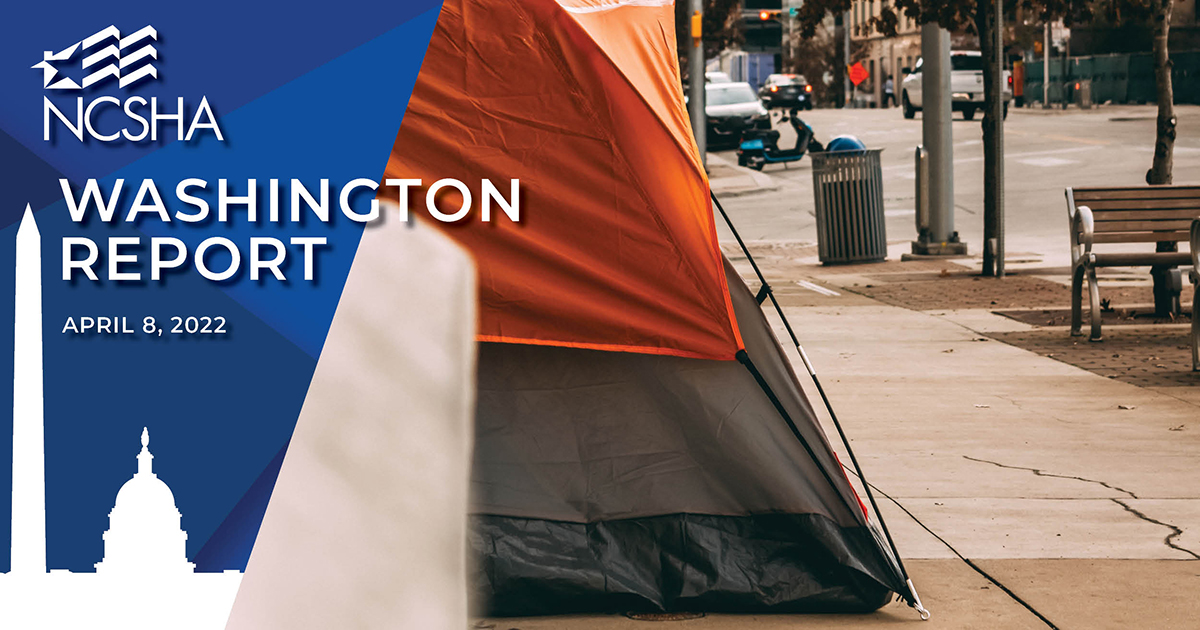
Dozens of cities across the U.S. are clearing encampments of unhoused people and “pushing other strict measures to address homelessness that would have been unheard of a few years ago,” reports the Los Angeles Times.
Mayors are acting out of concern for human dignity and public health as well as safety complaints by business leaders and local residents that NPR says have become “politically urgent in cities where pandemic-era tolerance policies have allowed the camps to sprawl into more visible areas.”
Whether the camps cause crime is unclear to researchers. Much clearer are the connections between housing instability, homelessness, and incarceration — a long-running vicious cycle which in recent years has fueled an explosion of encampments “in numbers not seen in almost a century,” according to Abt Associates.
While “research is sorely lacking on how housing instability beyond homelessness can lead to incarceration,” a 2019 study found “incarcerated populations experienced significant residential instability prior to detention.” At the same time, “formerly incarcerated people are almost 10 times more likely to be homeless than the general public,” according to a 2018 report from the Prison Policy Initiative.
There’s considerable evidence that “unstable housing after incarceration increases the likelihood of reoffending and thus re-incarceration.” Conversely, access to affordable housing can help people on probation stay on the right side of the law, especially lower-risk former offenders. In fact, they “may not recidivate, but for unstable housing and homelessness,” according to another recent paper.
You can see it with your own eyes in Georgia. The state’s Reentry Partnership Housing program provides short-term housing and other services to homeless individuals re-entering society from prison. The Georgia Department of Community Affairs, one of several state agencies involved, reports that “most individuals in the program successfully integrate back into society by obtaining employment and accessing stable housing upon their release from the program.”
The program has also enabled the state to save money and focus more justice system resources on the most violent offenders. Adam Gelb, president and CEO of the Council on Criminal Justice, said when he was previously at the Pew Charitable Trust, “From a national vantage point, Georgia continues to set a very high bar for other states in both the approach it’s taken and the results it’s getting.”
Ultimately, longer-term solutions are needed too, in the form of permanent affordable housing and supportive services. The Housing Credit program, which the Boston Federal Reserve has shown “does significantly reduce homelessness” at the county-wide level, should be expanded. State and Local Fiscal Recovery Funds should be optimized for housing development. State and local plans for using their HOME-ARP funds should be submitted and approved by HUD as quickly as possible.
The hard reality is that all this will take time. And clearing the camps now may make it harder to get their residents into temporary or permanent housing, whenever it becomes available. In too many American cities, there are simply no good options.

Stockton Williams | Executive Director
State HFA Emergency Housing Assistance
In This Issue
- Senate Narrowly Votes to Advance Gordon’s FHA Nomination to Senate Floor
- FHFA, GSEs Announce Foreclosure Suspensions for Mortgages in HAF Processing
- Joint Center for Housing Studies Says ERA Assistance Highly Targeted
- NH&RA Commemorates 50th Anniversary
- Looking Ahead
Senate Narrowly Votes to Advance Gordon’s FHA Nomination to Senate Floor
The Senate Wednesday morning voted to approve a discharge petition clearing for floor consideration Julia Gordon’s nomination to serve as Commissioner of the Federal Housing Administration/Assistant Secretary for Housing. The petition was approved by a party-line 50 – 50 vote, with all Democrats in support and all Republicans opposed. Vice President Kamala Harris broke the tie to approve the petition. The discharge petition was necessary to advance the nomination because the Banking Committee tied 12 – 12, again on party lines, when it voted on her nomination in January. It is not yet known when the full Senate will consider and vote on Gordon’s nomination. NCSHA previously has expressed our support for Gordon’s nomination because of her experience and strong support for affordable housing.
FHFA, GSEs Announce Foreclosure Suspensions for Mortgages in HAF Processing
On Wednesday, the Federal Housing Finance Agency announced Fannie Mae and Freddie Mac generally will require servicers to suspend foreclosure activities for up to 60 days if a servicer has been notified that a borrower has applied for assistance under the Treasury Department’s Homeowner Assistance Fund. Fannie Mae then released an updated servicing lender letter, LL-2021-02, and Freddie Mac issued Bulletin 2022-8 to provide guidance to servicers of their mortgage loans.
Joint Center for Housing Studies Says ERA Assistance Highly Targeted
In an April 6 blog, Harvard’s Joint Center for Housing Studies (JCHS) reported Emergency Rental Assistance (ERA) funds have reached households who need it most. Analyzing Treasury Department data, JCHS found about two-thirds of households who received assistance in 2021 were extremely low income, meaning they had household incomes below 30 percent of area median income. Additionally, demographic data indicates 48 percent of ERA recipients were Black, 39 percent were White, 21 percent were Hispanic (of any race), two percent were Asian, and two percent were American Indian or Native American (of any ethnicity). Using data from Treasury and the U.S. Census Bureau, JCHS also found that more than one in every 10 renter households across the country had applied for ERA as of early February 2022, with more than one-third of applicants receiving assistance, another 38 percent awaiting a decision, and a quarter denied.
NH&RA Commemorates 50th Anniversary
In honor of its 50th anniversary, the National Housing & Rehabilitation Association (NH&RA) has released a special edition of its publication Tax Credit Advisor. The cover story, “Affordable Across America,” shares 50 projects that form an historical record of the affordable housing industry spanning decades and subsidy types. This April 2022 edition is available to read here. Congratulations, NH&RA!
Legislative and Regulatory Activities
- April 14 | Comments Due | Treasury Department Proposed Guidance on Homeowner Assistance Fund Participant Compliance and Reporting Responsibilities
- May 2 | Comments Due to NCSHA | HUD Proposed Rule on Increased 40-Year Term for Loan Modifications
- May 6 | Comments Due to NCSHA | Labor Department Proposed Rulemaking to Update Davis-Bacon Act Regulations
- May 17 | Comments Due | Labor Department Proposed Rulemaking to Update Davis-Bacon Act Regulations
- May 31 | Comments Due | HUD Proposed Rule on Increased 40-Year Term for Loan Modifications
NCSHA, State HFA, and Industry Events
- April 28 – 29 | Novogradac Affordable Housing Conference | San Francisco and Online
Jennifer Schwartz will speak at this event. - May 2 – 4 | Mountain Plains HFA Summit | Billings, MT
Garth Rieman will speak at this event. - May 11 – 12 | Outside the Box: 2022 PHFA Housing Forum | Harrisburg, PA
Jennifer Schwartz will speak at this event. - June 8 – 9 | CAHEC Partners Conference | Greensboro, NC
Stockton Williams will speak at this event. - June 21 – 24 | NCSHA’s Housing Credit Connect | Chicago
Back to NCSHA Washington Report
Only members receive NCSHA Blog and Washington Report.