NCSHA Washington Report | April 5, 2024
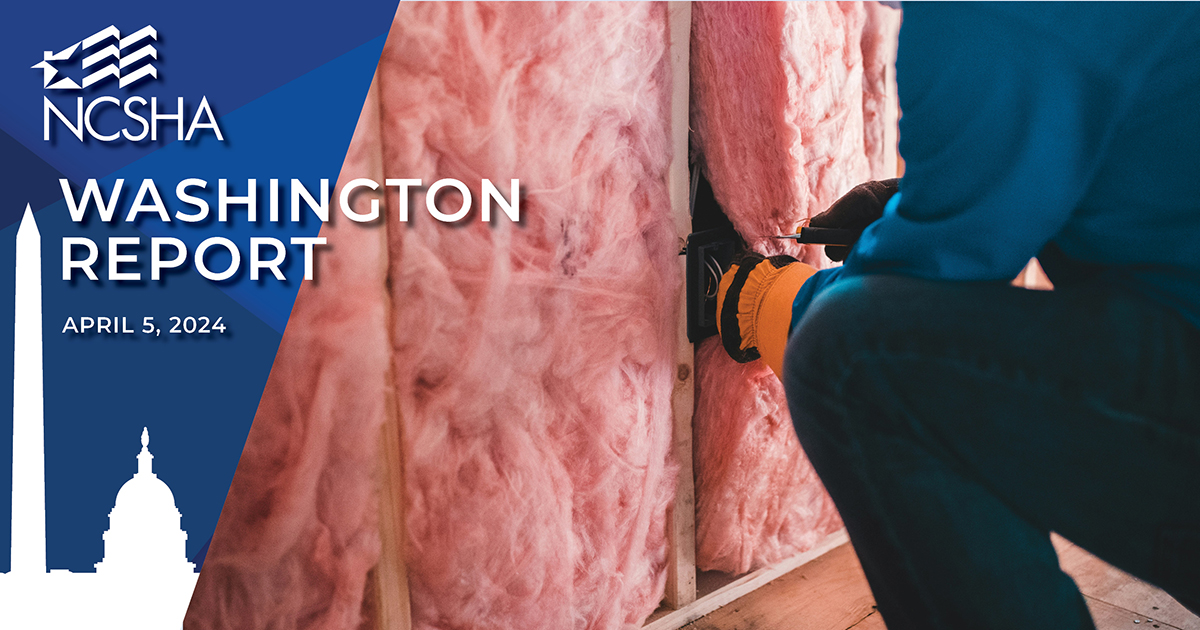
The first flagship initiative of the Federal Housing Administration was not the home purchase mortgage insurance program the agency is known for today but rather a home improvement program authorized under the first title of the landmark 1934 law that created the agency.
The fact that for FHA “the cumulative number of [Title I] property improvement loans was greater than the number of home mortgage program loans until the financial crisis of 2008” is amazing to consider, given both the massive growth of the latter starting after World War II and the former’s more recent “drift into obscurity.”
HUD has proposed several statutory changes to revitalize the Title I property improvement program (and recently announced regulatory updates to the part that applies to manufactured homes). The department’s focus on home repair is welcome and aligns with a surge in activity in the states.
New York Governor Hochul (D) last month announced awards of $50 million through a new state initiative she championed. Iowa rolled out a new program, using federal Homeowner Assistance Funds, in January. The centerpiece of Pennsylvania Governor Shapiro’s (D) housing agenda is a $50 million expansion of a successful “whole homes” program, which has also inspired the introduction of federal legislation sponsored by Senators Fetterman (D-PA) and Lummis (R-WY).
About half the state HFAs have one or more dedicated programs. While some are long-running, as in Minnesota and North Carolina, more than one-third of them have come online since 2021, resulting in thousands of repairs annually. These are in addition to the thousands of HOME program-funded rehabs, federal weatherization upgrades, and emergency fixes HFAs fund every year. (If Congress were to pass the Affordable Housing Bond Enhancement Act sponsored by Senators Cortez Masto (D-NV) and Cassidy (R-LA), an NCSHA priority, HFAs also would be able to use mortgage revenue bonds to finance home improvement loans.)
Innovation is happening at the local level, too. Noting “residents with lower incomes, seniors, and Black homeowners are more likely to have unaddressed housing repairs, live in substandard housing, and have less financial capacity to make improvements than higher-income homeowners,” the Housing Solutions Lab at New York University’s Furman Center last week announced a new “peer network” of seven local efforts.
There’s a lot to do. A 2023 report from the Philadelphia Federal Reserve Bank reported that overall housing conditions had worsened significantly for low-income homeowners since 2018 and required $57 billion in improvements. “Over one-quarter of low-income homeowners are both energy-burdened and have at least one significant need, with an average repair cost of $4,444,” bank analysts found. Michael Neal and his Urban Institute colleagues recently documented the disproportionate harms substandard homes have for households of color.
Low-income home repair remains a sleeper solution to multiple problems — even beyond its most obvious benefits of bolstering affordable housing supply. Relatively modest upgrades have been shown to cut owners’ energy expenses significantly and improve respiratory health, leading in some cases to fewer school and work absences and hospitalizations. They help economically vulnerable owners remain in their homes. Neighborhood-wide efforts have stabilized property values and reduced violent crime.
Once again, what’s old is new again in affordable housing. Anyone looking to get up to speed on the latest in home repair programs, policy, and financing should tune in April 17 to our national virtual symposium.

Stockton Williams | Executive Director
In This Issue
- Hutto Named SC Housing Executive Director
- HOME Coalition Delivers FY25 Funding Letter to Appropriators
- Administration Announces Greenhouse Gas Reduction Fund Awards
- HUD Awards $173 Million for GRRP Energy Retrofits
- HUD Publishes 2024 Income Limits for HUD and Tax Programs
- Judge Stays New CRA Rule Implementation While Lawsuit Advances
- FHA Extends Face-to-Face Meeting Waiver Deadline
- USDA Modifies Section 538 Program Selection Criteria, Paving the Way for Qualified Contract Waiver Priority
- Rural Housing Service Issues Proposed Rule on Credit Reporting for Select Multifamily Programs
- Treasury, IRS Release 2024 Clean Energy Guidance for Low-Income Communities Bonus Credit Program
- FHFA Provides Update on FHLB Report Recommendations
- NCSHA in the News
- Looking Ahead
Hutto Named SC Housing Executive Director
Richard Hutto has been appointed executive director of the South Carolina State Housing Finance and Development Authority (SC Housing) by the Board of Commissioners. Since June, Hutto had served as the agency’s interim executive director. His 38 years of service in finance and affordable housing include key roles at SC Housing and in the office of the South Carolina state treasurer.
HOME Coalition Delivers FY25 Funding Letter to Appropriators
The HOME Coalition, which NCSHA chairs, sent a letter this week to House and Senate appropriators and leadership urging fiscal year 2025 (FY25) funding for the HOME Investment Partnerships Program of no less than $2.5 billion. The letter, signed by more than 800 national, state, and local organizations, argues HOME is HUD’s flagship affordable housing production program, is one of the most effective and flexible tools states and localities have to meet their affordable housing needs, and deserves significant resources to help communities address high costs of rental and for-purchase housing.
Administration Announces Greenhouse Gas Reduction Fund Awards
Yesterday, the Biden Administration announced $20 billion in awards for the Environmental Protection Agency’s Greenhouse Gas Reduction Fund (GGRF), one of the signature initiatives authorized by the Inflation Reduction Act. The announcement included $14 billion for the National Climate Investment Fund (NCIF) to provide financing for projects around the country, potentially including for affordable housing developments, and $6 billion for the Clean Communities Investment Accelerator (CCIA) for capacity-building assistance to community lenders. The NCIF awards are $6.97 billion to Climate United, a nonprofit formed by Calvert Impact; $5 billion to the Coalition for Green Capital; and $2 billion to Power Forward Communities, a coalition led by Enterprise Community Partners, the Local Initiatives Support Corporation (LISC), Habitat for Humanity International, Rewiring America, and United Way Worldwide. The five CCIA awardees are the Opportunity Finance Network ($2.29 billion), Inclusiv ($1.87 billion), Native CDFI Network ($400 million), Justice Climate Fund ($940 million), and Appalachian Community Capital ($500 million).
EPA will host informational webinars on the NCIF on April 10 at 1:00 pm ET (join briefing) and the CCIA on April 11 at 1:00 pm ET (join briefing). The webinar recordings and announcements about future webinars will be posted on EPA’s GGRF webpage.
HUD Awards $173 Million for GRRP Energy Retrofits
On March 28, Acting Secretary Adrianne Todman announced the U.S. Department of Housing and Urban Development (HUD) has awarded more than $173 million in new Green and Resilient Retrofit Program (GRRP) grants and loans to support energy efficiency and climate resilience improvements at HUD-supported multifamily properties around the country, including the first GRRP awards in Colorado, Florida, Mississippi, North Carolina, Oregon, and Washington. GRRP funding can be used for insulation, energy-efficient windows and doors, and heating and cooling for properties receiving some form of HUD assistance, including Section 8 project-based rental assistance, Section 202 assistance for low-income seniors, and Section 811 assistance for low-income persons with disabilities.
In addition to announcing the GRRP awards, HUD noted the ongoing availability of free energy and water benchmarking services for HUD-assisted properties to measure resource usage and efficiency. Interested property owners can learn more about HUD’s benchmarking services here. HUD also updated its GRRP notices of funding opportunity for the Elements, Leading Edge, and Comprehensive cohorts and announced it will accept applications for each cohort through May 15, June 12, and July 31, respectively.
HUD Publishes 2024 Income Limits for HUD and Tax Programs
On April 2, HUD issued 2024 income limits for various HUD multifamily housing programs and separately for Multifamily Tax Subsidy Projects, which include the Housing Credit and Multifamily Housing Bonds. HUD modified the methodology it uses to set income limits this year by capping increases at no more than 10 percent. Because the Housing Credit and Multifamily Bond programs use income limits to determine the rent owners may charge, this change also establishes a 10 percent cap on rents for properties financed by those programs. NCSHA supported the cap when HUD first proposed it in January. For more information on the change in methodology, see NCSHA’s blog. The HOME program has its own income limits, which HUD intends to publish later this month.
Judge Stays New CRA Rule Implementation While Lawsuit Advances
Last Friday, a federal judge issued a preliminary injunction preventing federal banking regulators from implementing a recently published rule overhauling their Community Reinvestment Act (CRA) regulations. The rule, which was issued by the Federal Reserve, Office of the Comptroller of the Currency, and Federal Deposit Insurance Corporation, was set to go into effect April 1. The injunction was requested as part of a lawsuit filed in February in the Northern District of Texas by several organizations representing the financial services industry, including the American Bankers Association, Independent Community Bankers of America, U.S. Chamber of Commerce, and several Texas-based associations. The suit argues regulators arbitrarily exceeded their authority and published a final rule that is needlessly complex and burdensome and ultimately will hinder the CRA’s mission to promote banks’ investments in the communities they serve. In his opinion granting the preliminary injunction, U.S. District Judge Matthew Kacsmaryk ruled the plaintiffs are likely to prevail in their suit against the rule. The preliminary injunction will remain in place until the lawsuit is resolved. NCSHA previously summarized the CRA rule in our blog.
FHA Extends Face-to-Face Meeting Waiver Deadline
Yesterday, the Federal Housing Administration (FHA) extended through January 1, 2025, its temporary regulatory waiver and related Single-Family Housing Policy Handbook 4000.1 waiver allowing servicers to use alternative methods to communicate with borrowers in lieu of face-to-face meetings if certain protocols are followed. FHA is extending the waiver to keep it in place while HUD finalizes its proposed rule, Modernization of Engagement with Mortgagors in Default (Docket No. FR-6353- P-01), and associated implementation guidance. NCSHA submitted comments on this proposed rule on September 5, expressing support for HUD’s proposal to expand its current face-to-face meeting requirement for defaulted borrowers to a broader range of communication methods. The temporary regulatory waiver is now extended through January 1, 2025, unless the final rule amending FHA’s related regulatory requirements and a new mortgagee letter or Handbook 4000.1 update become effective sooner.
USDA Modifies Section 538 Program Selection Criteria, Paving the Way for Qualified Contract Waiver Priority
Last month, USDA’s Rural Housing Service (RHS) published a final rule amending the application selection criteria for the Section 538 Guaranteed Rural Rental Housing Program. The changes remove priority points for bedroom counts and lower interest rates, which RHS believes no longer align with its priorities, and provide greater flexibility for RHS to set priority criteria. The agency will announce the priority criteria in a notice in the Federal Register later this year.
In an email update to stakeholders about the final rule’s publication, RHS Administrator Joaquin Altoro said the notice will address the preservation challenge caused by qualified contracts by providing priority points for 538 loan guarantees for Housing Credit properties if the developer agrees to waive its right to a qualified contract. NCSHA and other preservation advocates have urged RHS to help mitigate the early termination of Housing Credit properties through qualified contracts by creating incentives for owners to waive that right as a condition of receiving 538 loan guarantees.
Rural Housing Service Issues Proposed Rule on Credit Reporting for Select Multifamily Programs
Last week, USDA’s Rural Housing Service published a proposed rule that would update the process for obtaining and submitting credit reports under the Section 514, Section 515, and Section 516 Multifamily Housing Direct Loan and Grant programs. The proposed rule would require an applicant to submit a credit report as part of their application. Current regulations require RHS to order a credit report for a potential borrower after their application is received. RHS believes this adjustment will eliminate processing delays and remove required contractual services used during the current application process. RHS is accepting comments on the proposed rule through May 28. NCSHA would appreciate HFA input as we prepare a response. Please email any feedback to Glenn Gallo.
Treasury, IRS Release 2024 Clean Energy Guidance for Low-Income Communities Bonus Credit Program
Earlier this week, the U.S. Department of the Treasury and the Internal Revenue Service announced new 2024 guidance for the Low-Income Communities Bonus Credit Program (also referred to as Section 48(e)), which provides a 10 or 20 percent boost to the Investment Tax Credit (ITC). The ITC is a tax credit available for qualified solar or wind facilities in low-income communities, on Indian land, as part of affordable housing developments, and/or benefitting low-income households. The Low-Income Communities Bonus Credit Program was enacted in the Inflation Reduction Act of 2022, which also allowed Housing Credit properties that rely on clean energy facilities covered by the ITC to benefit from both tax credits by eliminating the basis reduction previously required under the tax code.
The new guidance for the 2024 program year — its second year — provides clarifying changes to the application, documentation, and lottery procedure as compared to the first year of the program. The Low-Income Communities Bonus Credit Program is made available under a competitive application process, opening for applications during the second quarter of 2024. The opening and closing dates of the application period will be posted on the U.S. Department of Energy’s program landing page when the dates are available.
FHFA Provides Update on FHLB Report Recommendations
The Federal Housing Finance Agency (FHFA) Wednesday issued a press release highlighting its efforts to implement the recommendations outlined in its November 2023 report Federal Home Loan Bank System at 100: Focusing on the Future. The report addresses several policies FHFA intends to pursue in 2024 to increase the Federal Home Loan Banks’ (FHLB) support for housing and community development. The release notes that, on Wednesday, FHFA published a regulatory interpretation of how Puerto Rico cooperatives, a type of state-chartered credit union, can become members of the FHLB system.
In a separate bulletin, FHFA communicated its expectation that each FHLB would establish a framework for pilot and voluntary programs by March 29. Other housing and community development priorities FHFA intends to pursue this year include establishing mission-oriented collateral programs at the FHLBs, streamlining the Affordable Housing Program regulations, and allowing for longer maturity terms for long-term advances. FHFA has published a webpage with more information on its efforts to implement the FHLB report’s recommendations.
NCSHA in the News
Poughkeepsie Journal. 3.26.24, Buying your first home is daunting. Here are some resources to help cut the cost
NAHB Blog, 3.26.24, NAHB Honors Jerry Howard with National Housing Center Award
Bluefield Daily Telegraph, 3.22.24, Warner and Kaine cosponsor legislation to help first-generation home buyers
Business Insider, 3.22.24, HFA Loans: A Guide for First-Time Home Buyers
Legislative and Regulatory Activities
- April 5 | Comments Due to NCSHA | USDA Single-Family Housing Guaranteed Loan Program Loan Servicing Policy Changes
- April 10, 1 – 1:30 pm (Eastern) | EPA Webinar on the National Climate Investment Fund
- April 11, 1 – 1:30 pm (Eastern) | EPA Webinar on the Clean Communities Investment Accelerator
- April 12 | Comments Due | USDA Single-Family Housing Guaranteed Loan Program Loan Servicing Policy Changes
- April 15 | Comments Due | Build America, Buy America Request for Input
NCSHA, State HFA, and Industry Events
- April 12 | Last Day to Register | NCSHA April 17 Symposium: Preserving Owner-Occupied Affordable Homes | Virtual
- April 15 – 17 | Nebraska Investment Finance Authority’s Innovation Expo | Lincoln, NE
Jennifer Schwartz will speak at this event. - April 17, 12:30 – 5:15 pm ET | NCSHA Symposium: Preserving Owner-Occupied Affordable Homes | Virtual
- April 30 – May 2 | 2024 Affordable Housing Investors Council Spring Meeting | Milwaukee, WI
Garth Rieman will speak at this event. - May 1, 11:59 pm ET | Entry Deadline | NCSHA’s 2024 Awards for Program Excellence
- May 1 – 2 | Pennsylvania Housing Finance Agency’s 2024 Housing Forum | Harrisburg, PA
Jennifer Schwartz will speak at this event. - May 2 | National Association of Local Housing Finance Agencies’ 2024 Annual Conference | Las Vegas, NV
Robert Henson will speak at this event.