NCSHA Washington Report | April 22, 2022
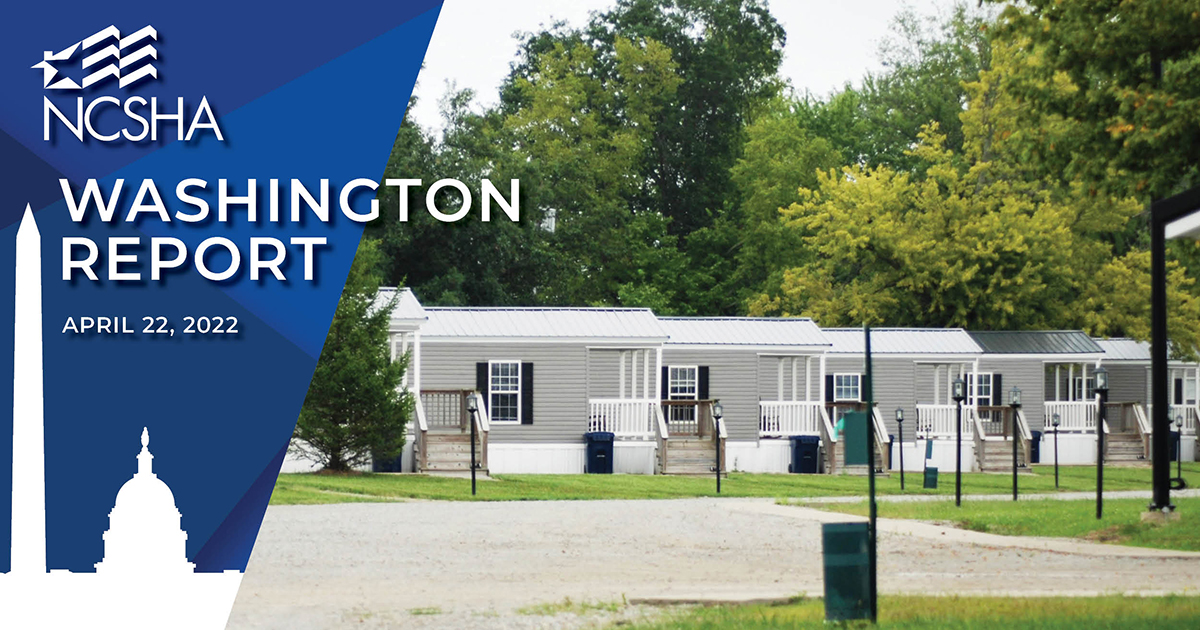
NCSHA’s Greg Zagorski and I were pleased to speak virtually this week with officials from 10 federal agencies and state housing and energy agency stakeholders in manufactured housing about opportunities to increase the supply and improve the efficiency of this underappreciated segment of the market.
The federal agencies are working in a task force the administration convened “to address market and regulatory barriers to manufactured housing as an affordable, equitable, and accessible housing option, with a particular focus on financing.”
The backdrop of the effort is a forthcoming increase in federal energy-efficiency standards for new manufactured homes the Department of Energy acknowledges could lead to higher upfront costs for some consumers, with a potential payoff of greater operating savings in the future.
If manufactured homes can be easy to overlook, their importance to housing affordability is hard to overstate.
More than 17 million people live in America’s nearly seven million manufactured homes, according to the Consumer Financial Protection Bureau (CFPB). Their median income is about $35,000 per year, according to Fannie Mae. Former Freddie Mac CEO David Brickman calls manufactured homes “the nation’s largest source of unsubsidized affordable housing and 13 percent of occupied homes in rural communities and small towns.”
They account for almost 10 percent of new single-family starts these days and typically can be delivered at about half the price of new stick-built homes. Nevertheless, annual deliveries have declined substantially over the past two decades, and Fannie reports that “the share of manufactured homes compared to all homes sold currently stands at 14 percent, which is below the 25–30 percent range recorded prior to 2000.”
Restrictive local zoning, and in some places a poor public perception, stymies new development. Another problem is financing. Buyers who don’t have the option of buying the land their homes are sited on have to rely on chattel financing, which tends to be more expensive and less liquid than conventional home mortgage loans. And there’s little competitive pressure to reduce financing costs: The top five lenders account for more than 40 percent of manufactured home purchase loans and 75 percent of chattel lending, according to CFPB.
HFAs are innovating in addressing these challenges. New Hampshire HFA has piloted several product options with Fannie that the company says “will serve as the basis for Fannie Mae’s expansion into this space.” The State of New York Mortgage Agency provides mortgage financing for buyers of manufactured homes on leased land.
Connecticut HFA offers manufactured home owners a refinance option that can cut their monthly housing cost by 35 percent. Minnesota Housing funds infrastructure improvements to help keep manufactured home communities viable and accessible.
Overall, 28 state HFAs originate or purchase manufactured home loans and 40 percent have resumed or expanded manufactured home loan products recently. There’s a lot more HFAs could do with more supportive federal policies.
We look forward to working with the federal task force.

Stockton Williams | Executive Director
State HFA Emergency Housing Assistance
In This Issue
- Coons, Beatty Seek Congressional Support for FY 2023 HOME Funding
- Legislation Introduced to Amend Opportunity Zones Tax Incentive
- FHA Adds 40-Year Loan Modification to Covid Recovery Loss Mitigation Options
- HUD Publishes Income Limits for HUD-Assisted Housing, Tax Programs
- Barr Nominated to Be Federal Reserve Vice Chair for Supervision
- Novogradac Analysis Finds Housing Credit Does Not Further Concentration of Poverty, Racial Segregation
- NCSHA in the News
- Looking Ahead
Coons, Beatty Seek Congressional Support for FY 2023 HOME Funding
Senator Chris Coons (D-DE) and Representative Joyce Beatty (D-OH) are circulating “Dear-Colleague” letters in their respective chambers seeking support for increased funding for the HOME Investment Partnerships (HOME) program in FY 2023. The House letter supports at least $2.5 billion for HOME, and the Senate letter at least $2.1 billion. The deadline for representatives to sign the House letter is Wednesday, April 27; the Senate letter is open until Friday, May 6. Please reach out to your members of Congress and ask them to sign on in support of HOME.
NCSHA, in its capacity as convener of the HOME Coalition, soon will send a national housing industry sign-on letter to congressional leadership in both chambers urging Congress to provide at least $2.5 billion for HOME in FY 2023. For nearly three decades, HOME has been one of the most effective and flexible tools states and localities have had to meet their affordable housing needs. HOME can be used to build and preserve affordable rental housing and to build new single-family housing, as well as for homeowner rehabilitation, tenant-based rental assistance, and homeownership assistance. HOME is more critical than ever as we work to tackle rising housing inflation and navigate the ongoing impacts of the Covid-19 pandemic on the nation’s housing market. Today is the last day to add your organization’s name to the HOME Coalition’s sign-on letter here.
Legislation Introduced to Amend Opportunity Zones Tax Incentive
Senators Cory Booker (D-NJ) and Tim Scott (R-SC), along with Representatives Ron Kind (D-WI) and Mike Kelly (R-PA), introduced legislation this month to reform and improve the Opportunity Zones (OZ) tax incentive. The Opportunity Zones Improvement, Transparency, and Extension Act (H.R. 7467/S. 4065) would extend the OZ incentive through the end of 2028, expand reporting requirements to provide more transparency into how the incentive is working, provide for the early sunset of certain high-income Opportunity Zones and designation of new zones, allow Qualified Opportunity Funds (QOFs) to invest in other QOFs, and establish a State and Community Dynamism Fund to provide financial support, technical assistance, and capacity building to underserved communities.
FHA Adds 40-Year Loan Modification to Covid Recovery Loss Mitigation Options
On Monday, the Federal Housing Administration (FHA) released Mortgagee Letter 2022-07, which adds a 40-year-term loan modification and partial claim to FHA’s Covid-19 recovery loss mitigation options. The policy is meant to help homeowners reach a targeted 25 percent reduction on the monthly principal and interest portions of their mortgage payments when other Covid-19 recovery loss mitigation options are unable to do so, enabling more homeowners to retain their homes.
FHA is providing an exemption for mortgagees servicing mortgages funded in connection with mortgage revenue bonds (MRBs) if they cannot extend the term of a mortgage beyond the original 30 years or the interest rate cannot be modified, as NCSHA advocated. In our October 29 comments to the Department of Housing and Urban Development (HUD) on its original proposal, we detailed the negative impact the proposed policy would have on HFA homeownership programs and the low-income borrowers they serve. We appreciate FHA’s responsiveness to our concerns.
HUD Publishes Income Limits for HUD-Assisted Housing, Tax Programs
This week, HUD issued 2022 income limits to determine eligibility for various HUD-assisted housing programs, including the public housing, Section 8 project-based, Section 8 Housing Choice Voucher, Section 202 Housing for the Elderly, and Section 811 Housing for Persons with Disabilities programs. HUD issued separate 2022 income limits for Multifamily Tax Subsidy Projects, used to determine eligibility for Housing Credits and tax-exempt housing bonds. Both sets of income limits are effective immediately. Neither set of income limits applies to the HOME Investment Partnerships and Housing Trust Fund programs; income limits for those programs are released later in the year and have a different effective date.
Barr Nominated to Be Federal Reserve Vice Chair for Supervision
President Biden last Friday announced he will nominate Michael Barr to serve as vice chair for supervision of the Federal Reserve Board. In this role, Barr would be responsible for crafting proposed regulations and other policies governing the large banks that fall under the Federal Reserve’s oversight jurisdiction. Barr is currently a dean and professor at the University of Michigan. During the Obama Administration, he served in the Treasury Department as assistant secretary for financial institutions. While there, he helped develop the Dodd-Frank Wall Street Reform Act and set up the Consumer Financial Protection Bureau. Barr also worked at Treasury during the Clinton Administration. Biden nominated Barr after his first nominee for the post, Sarah Bloom Raskin, withdrew.
Novogradac Analysis Finds Housing Credit Does Not Further Concentration of Poverty, Racial Segregation
Novogradac this week released an analysis of Housing Credit development siting that challenges criticisms the program concentrates affordable housing in high-poverty and racially segregated areas. Unlike some previous analyses of Housing Credit siting, Novogradac separates new construction properties from rehabilitation, as properties in need of rehabilitation have pre-determined locations, and thus the Credit does not further concentrate poverty or exacerbate segregation in those cases. Looking at the locations of only new construction properties tells a very different story.
Novogradac finds that not only are Housing Credit new construction properties more likely to be located in lower-poverty census tracts and outside census tracts composed of majority-black, indigenous, and people-of-color (BIPOC) populations than Housing Credit developments overall but, in recent years, Housing Credit developments as a whole have trended more toward locations in low-poverty, majority non-BIPOC census tracts. This indicates state policies to encourage building in higher-opportunity areas are working. Novogradac notes that barriers to development in low-poverty, majority non-BIPOC areas, such as exclusionary zoning, are not specific to Housing Credit properties and also can be challenges for market-rate rental development.
NCSHA in the News
Affordable Housing Finance, 4.15.22, Affordable Housing Groups Raise Alarms about Global Minimum Tax
The U.S. Sun, 4.20.22, Thousands of homeowners can get up to $2,000 credit each year – do you qualify?
Legislative and Regulatory Activities
- April 22 | Signature Deadline | HOME Coalition National Sign-On Letter Urging Congress to Provide $2.5 Billion for HOME in FY 2023
- May 2 | Comments Due to NCSHA | HUD Proposed Rule on Increased 40-Year Term for Loan Modifications
- May 6 | Comments Due to NCSHA | Labor Department Proposed Rulemaking to Update Davis-Bacon Act Regulations
- May 17 | Comments Due | Labor Department Proposed Rulemaking to Update Davis-Bacon Act Regulations
- May 31 | Comments Due | HUD Proposed Rule on Increased 40-Year Term for Loan Modifications
NCSHA, State HFA, and Industry Events
- April 28 – 29 | Novogradac Affordable Housing Conference | San Francisco and Online
Jennifer Schwartz will speak at this event. - May 2 – 4 | Mountain Plains HFA Summit | Billings, MT
Garth Rieman will speak at this event. - May 11 – 12 | Outside the Box: 2022 PHFA Housing Forum | Harrisburg, PA
Jennifer Schwartz will speak at this event. - May 23 | NCSHA’s Housing Credit Connect: Last Day for Registration and Hotel Discounts | Chicago
- May 25 – 27 | ABA Forum on Affordable Housing and Community Development Law Annual Conference | Washington, DC
Jennifer Schwartz will speak at this event. - June 8 – 9 | CAHEC Partners Conference | Greensboro, NC
Stockton Williams will speak at this event. - June 21 – 24 | NCSHA’s Housing Credit Connect | Chicago
Back to NCSHA Washington Report
Only members receive NCSHA Blog and Washington Report.