
Resources

HOME Coalition Letter to Appropriators Seeking Funding for FY24
On October 2, 2023, the NCSHA-led HOME Coalition sent a letter to Appropriations Committee leaders in both chambers requesting robust funding for the HOME Investment Partnerships program as they wrap up appropriations legislation for Fiscal Year 2024. The letter requests no less than $1.5 billion for HOME, citing the critical need for this program due to many communities’ current housing supply challenges.
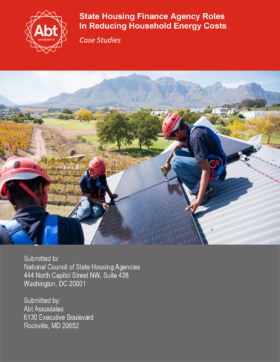
Reports: State Housing Finance Agency Roles in Reducing Household Energy Costs
Published by NCSHA in September 2023, two reports by Abt Associates profile HFA energy innovation and impact in eight states and examine potential new HFA roles in response to new federal investment in residential energy efficiency and renewable energy.
Qualified Contract Letter Sent to USDA
This October 25, 2023, letter, sent by NCSHA and other Housing Credit advocacy organizations to Secretary Vilsack, urges the Department of Agriculture to take actions to mitigate qualified contract early terminations of Housing Credit units that benefit from Section 538 multifamily housing loan guarantees.
NCSHA Letter to HUD on Early Termination of Qualified Contracts
This September 25, 2023, letter, sent by NCSHA and other Housing Credit advocacy organizations to Secretary Marcia L. Fudge, urges the U.S. Department of Housing and Urban Development (HUD) to take actions to mitigate qualified contract early terminations of Housing Credit units that benefit from HUD financing and Federal Housing Administration insurance.

184 Local Leaders Sign Onto Letter Supporting the Affordable Housing Credit Improvement Act
184 local government officials, representing cities, counties, and other municipalities of all sizes across the country, sent a letter to Congressional leadership supporting the Affordable Housing Credit Improvement Act (AHCIA) of 2023.
NCSHA Letter to HUD on Modernization of Engagement with Mortgagors in Default
On September 5, 2023, NCSHA responded to the U.S. Department of Housing and Urban Development’s proposed rule on Modernization of Engagement with Mortgagors in Default. NCSHA commended HUD's efforts to expand communication methods between mortgagees and defaulted homeowners, suggesting this expansion will improve loss mitigation efforts and home retention. Additionally, NCSHA encouraged HUD to define ‘reasonable effort’ and ‘verifiable attempt’ as broadly as possible. Upon implementation of the final rule, form HUD-2008-5-FHA Save Your Home: Tips to Avoid Foreclosure will be updated to include the expanded modes of communication.
Local Government Leaders’ Letter Supporting the Affordable Housing Credit Improvement Act
The ACTION Campaign, which NCSHA co-leads, is partnering with the National League of Cities, the National Association of Counties, and Mayors & CEOs for U.S. Housing Investment to circulate this letter in support of the Affordable Housing Credit Improvement Act of 2023 (AHCIA, S. 1557 | H.R. 3238).
NCSHA Letter to FHFA on Fannie, Freddie Single-Family Loan Pricing Framework
On August 14, 2023, NCSHA responded to the Federal Housing Finance Agency’s May 15 request for input on Fannie Mae and Freddie Mac’s framework for pricing single-family mortgages. The letter urged FHFA, when adjusting the pricing framework, to balance the need for the government-sponsored enterprises (GSEs) to maintain adequate capital with their public missions to support a liquid housing finance market, including for underserved markets. The letter also asked FHFA to continue to exempt loans originated through the GSEs’ HFA-specific products, as well as other loans for low- and moderate-income home buyers, from upfront mortgage fees.
NCSHA Comment Letter on FHFA’s Request for Input on Tenant Protections for Enterprise-Backed Multifamily Properties
In response to a request for input from the Federal Housing Finance Agency on tenant protections for enterprise-backed multifamily properties, NCSHA submitted these July 31, 2023, comments encouraging FHFA to protect tenants against displacement, rent increases, and possible evictions and to consider the potential impact of such protections on tenants, housing providers, lenders, and the government sponsored enterprises.