Testimony, Comments, Correspondence
State, Local Government and Housing Industry Sign-On Letter to Congressional Leaders on Using Fiscal Recovery Funds with the Housing Credit
This February 28 letter urges congressional leaders to amend the underlying statute of the Coronavirus State and Local Fiscal Recovery Fund to facilitate its use with the Housing Credit.

HOME Coalition Letter Supporting Maximum HOME Funding in Final FY22 Appropriations Bill
THOME Coalition sent a letter to leaders of the House and Senate Appropriations Subcommittees on Transportation, Housing and Urban Development (THUD) urging them to devote the maximum amount possible for the HOME program in a final FY 2022 appropriations bill. The letter supports the $1.85 billion for the HOME program that was included in the THUD appropriations bill passed by the House of Representatives in July 2021.
NCSHA Letter to Treasury on ERA Reporting Process
This letter outlines NCSHA’s concerns with the process for reporting to Treasury on the Emergency Rental Assistance (ERA) program. It urges Treasury to fix technology problems with its reporting portal, streamline reporting requirements, and provide technical assistance to ERA grantees.
Joint Letter in Support of HUD Nominees
This letter, signed by 46 national organizations, including NCSHA, supports the nominations of Julia Gordon for Commissioner of the Federal Housing Administration/Assistant Secretary for Housing, Solomon Greene for Assistant Secretary for Policy Development and Research; Arthur Jemison for Assistant Secretary for Public and Indian Housing, and David Uejio for Assistant Secretary for Fair Housing and Equal Opportunity.

Campaign for Housing and Community Development Funding Letter Supporting Passage of the Build Back Better Act
On January 21, 2022, the Campaign for Housing and Community Development Funding, of which NCSHA is a member, sent this letter to congressional leadership urging them to quickly enact the Build Back Better Act including its $154 billion in investments in critical housing and community development.
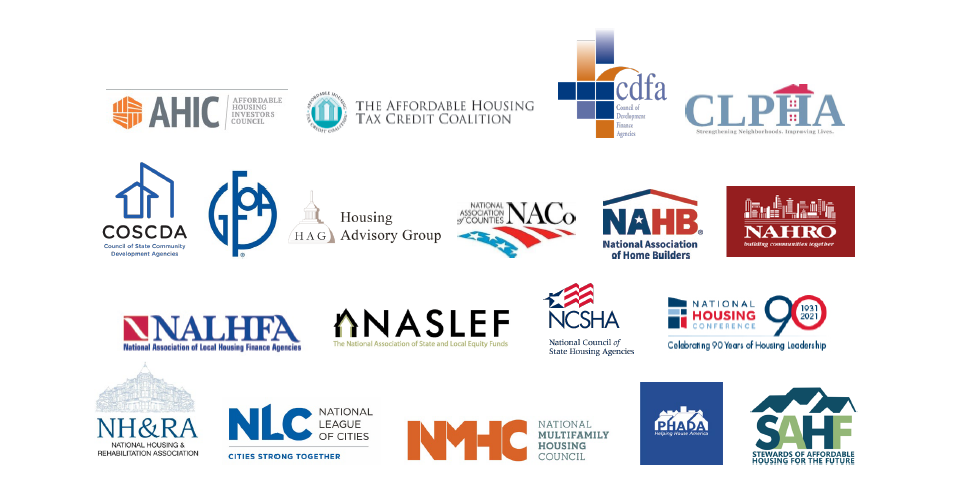
State and Local Government and Housing Industry Sign-On Letter to Secretary Yellen on Using Fiscal Recovery Fund with the Housing Credit
This December 10, 2021 letter, spearheaded by NCSHA and signed by 18 organizations representing state and local government officials and Housing Credit industry participants, urges U.S. Treasury Secretary Janet Yellen to modify existing guidance on the Coronavirus State and Local Fiscal Recovery Fund to provide more flexibility in the use of these funds in developments financed with the Housing Credit program.
NCSHA Summary of the First Generation Downpayment Fund
This summary provides details of the proposed “First Generation Down Payment Fund” program. This program has been included in the text of the “Build Back Better Act” that passed the House of Representatives on November 19, 2021. This summary reflects the Senate Banking Committee print of its provisions for the Build Back Better Act it released December 9. Originally published on October 29 and updated on December 13. NCSHA will update this summary as events warrant.
Housing Credit Stakeholder Sign-On Letter to IRS, Treasury on Average Income Test
NCSHA and 32 other Housing Credit Stakeholders organizations sent this letter to the Internal Revenue Service and the U.S. Department of Treasury urging them to issue a finale rule on the Housing Credit Average Income Test (AIT) minimum set-aside considering the modifications outlined in the letter or announce their intention to publish a new proposed rule for public comment.
Housing Credit Stakeholder Sign-On Letters in Support of Fixing Qualified Contracts, Right of First Refusal
These letters from NCSHA and other Housing Credit stakeholders to House Speaker Nancy Pelosi, House Ways and Means Committee Chair Richard Neal, Senate Majority Leader Charles Schumer, and Senate Finance Committee Chairman Ron Wyden express support for provisions in reconciliation legislation to close the qualified contract loophole and mitigate investor challenges to nonprofit developers seeking to exercise their statutorily given right of first refusal.