NCSHA Washington Report | November 5, 2021
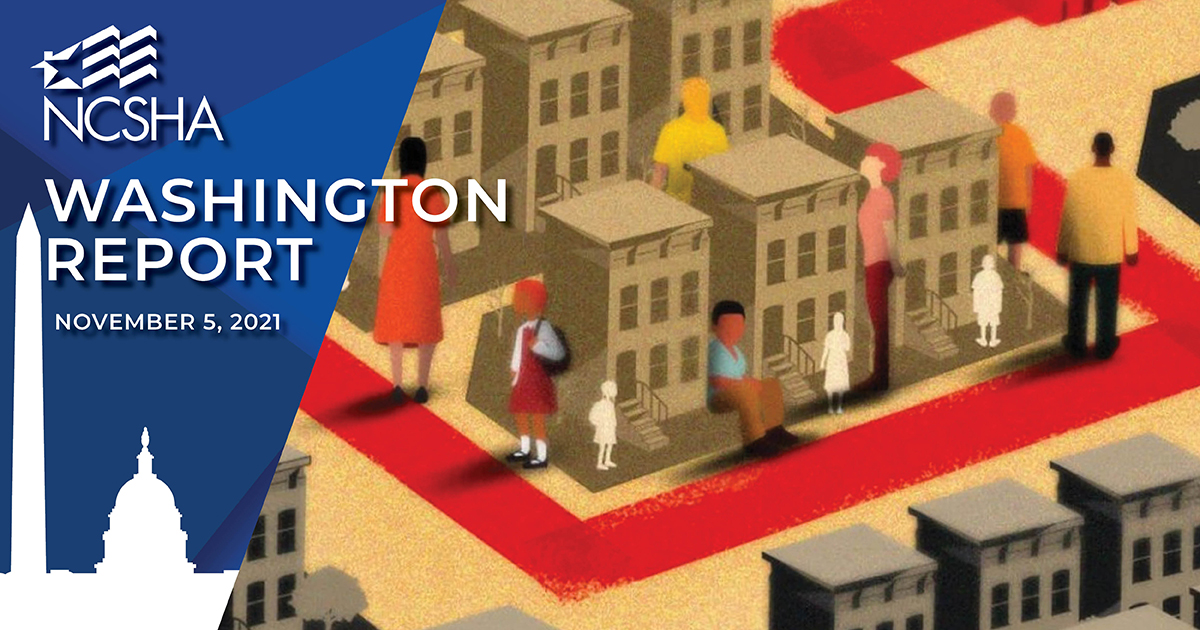
Candidate Biden promised to “close loopholes that would allow [nonbank financial institutions] to avoid lending and investing in all of the communities they serve.” President Biden’s White House issued a week-one statement acknowledging “[f]ederal policies contributed to mortgage redlining and lending discrimination against persons of color.”
In the months since then, HUD has settled more than 30 housing discrimination cases and announced a groundbreaking collaboration with FHFA on fair housing and fair lending enforcement. Two weeks ago, the Justice Department upped the ante, launching a “Combatting Redlining Initiative,” which it said, “[R]epresents the department’s most aggressive and coordinated enforcement effort to address redlining, which is prohibited by the Fair Housing Act and the Equal Credit Opportunity Act.”
At the time of the announcement, DOJ had already taken action against one bank to resolve allegations of redlining and since then has announced with other federal agencies resolution of similar action against another one.
Some are connecting the dots to find a broader pattern. A law firm white paper suggests:
Indeed, recent redlining enforcement suggests that not only will regulators allege it insufficient to treat all applicants and neighborhoods the same, but a lender must undertake affirmative action to specifically target minority neighborhoods. This approach attempts to impose unprecedented, CRA-like obligations on nonbank mortgage lenders…
Attorneys from another firm, writing in the National Law Review, assert: “The expansion of redlining investigations to encompass non-bank lenders represents a seismic shift in the Department’s historical approach to the investigation and enforcement of redlining.”
Progressive analysts approvingly point to “Biden’s Hardline Approach to End Redlining,” while mainstream business media reporters see the “U.S. crackdown on redlining coming … at a particularly awkward time for the financial industry,” because it could cast a pall on the most active period for bank mergers and acquisitions since the financial crisis — or at least make it more expensive.
This past Monday, New York became the fourth state in the country to expand its state community reinvestment law’s coverage to non-banks, following Connecticut, Illinois, and Massachusetts. Earlier this year, a New York State investigation focused on Greater Buffalo found nonbank lenders “had little or no engagement with local communities of color and made scant efforts to engage them.”
It is hard to envision the current Congress expanding the federal Community Reinvestment Act statute in a similar manner, even though candidate Biden campaigned on the idea and Federal Reserve Board Chair Jerome Powell has suggested he would welcome it if it happened.
In the meantime, the Fed will move forward with the FDIC and OCC to revise the CRA rules under current law. As for the Biden-Harris Administration, Attorney General Merrick Garland says, “We will spare no resource to ensure that federal fair lending laws are vigorously enforced and that financial institutions provide equal opportunity for every American to obtain credit.”

Stockton Williams | Executive Director
State HFA Emergency Housing Assistance
In This Issue
- House Leadership Working to Pass Build Back Better Act with Historic Housing Investments; Vote Could Slip
- NCSHA Raises Concerns About FHA 40-Year Loan Modification Proposal
- NCSHA Expresses Support for OCC CRA Proposal
- HUD Distributes $2 Billion in Disaster Aid to 10 States and Territories
- CDFI Fund Will Allocate $5 Billion in NMTCs
- NCSHA in the News
- Looking Ahead
- House Leadership Working to Pass Build Back Better Act with Historic Housing Investments; Vote Could Slip
House Leadership Working to Pass Build Back Better Act with Historic Housing Investments; Vote Could Slip
House Speaker Nancy Pelosi (D-GA) and her leadership team are working to line up the votes needed to pass the Build Back Better Act today. The bill would enact much of President Biden’s social policy agenda, including large investments in affordable housing programs. Unlike the draft text issued the previous week, the new version of the bill includes a major expansion and strengthening of the Housing Credit and establishes the Neighborhood Homes Credit.
Yet, moderate House Democrats may not be willing to vote on the bill until the Congressional Budget Office provides its official cost estimate for it, which could take weeks. Once passed in the House, the Build Back Better Act would go to the Senate for its consideration. It is likely that certain provisions of the bill will need to change if it is to get the support of all Democrats there, including moderate Senators Joe Manchin (D-WV) and Kyrsten Sinema (D-AZ), which is needed to advance the legislation. For more information on the House-passed Build Back Better Act, see NCSHA’s blog.
NCSHA Raises Concerns About FHA 40-Year Loan Modification Proposal
On October 29, NCSHA provided detailed comments to HUD about the negative impact its proposed 40-year loan modification (LM) would have on state HFA Mortgage Revenue Bond (MRB) programs. We requested that HUD either exempt state HFAs from this requirement or permit them to request and be granted a waiver. NCSHA’s letter describes how MRB programs work, how MRBs are structured, the important role they play in HFAs’ ability to provide affordable mortgage financing to first-time home buyers in their states, and how the 40-year LM would create a mismatch in the structured amortization of MRBs and the market disruption this could cause.
NCSHA Expresses Support for OCC CRA Proposal
NCSHA last Friday submitted comments to the Office of the Comptroller of the Currency (OCC) regarding its September proposed rule to amend its Community Reinvestment Act (CRA) regulations. NCSHA expressed support for OCC’s proposal, which would effectively rescind its current CRA rules, finalized in June 2020, and replace them with its previous CRA regulations while it works with other federal banking regulators to develop common CRA rules. NCSHA’s letter says the current CRA guidance could reduce bank investments in Housing Credits, Housing Bonds, and other needed community and economic development activities and urges OCC to include in any new CRA regulations a separate “investment test” and other mechanisms to incentivize such investments.
HUD Distributes $2 Billion in Disaster Aid to 10 States and Territories
HUD on Monday announced more than $2 billion in disaster recovery and climate resiliency funding for 10 states and territories through the CDBG-Disaster Recovery and CDBG-Mitigation programs. The funds were provided by the recently enacted FY 2021 continuing resolution, the Extending Government Funding and Delivering Emergency Assistance Act. The continuing resolution included $5 billion for disaster recovery and climate resiliency for major federally declared disasters that occurred in 2020 or 2021. HUD’s allocations respond to 15 major disasters that occurred during calendar year 2020 in the following 10 states and territories: Alabama, California, Florida, Iowa, Louisiana, Michigan, Mississippi, Oregon, Puerto Rico, and Tennessee. A breakdown of which disasters are covered and how much specific funding each state and territory received is available here. HUD will announce additional allocations from remaining funds in the next few months.
CDFI Fund Will Allocate $5 Billion in NMTCs
The Community Development Financial Institutions (CDFI) Fund announced Thursday it will allocate up to $5 billion in New Markets Tax Credits (NMTC) to eligible entities that apply by the January 13 deadline. Application materials will be published in the Federal Register on November 8. CDFI also announced changes to the NMTC program, including revised qualified equity investment issuance requirements, a new definition of controlling entity, and updates to the allocation application.
NCSHA in the News
Novogradac Journal of Tax Credits (Volume 12, Issue 11), 11.1.21, Low-Income Housing Tax Credits News Briefs — November 2021
Legislative and Regulatory Activities
- November 6 | Comments Due | HUD’s Climate Action Plan
- November 16 | Application Deadline | FR-6500-N-25, Notice of Funding Opportunity FY 2021 Continuum of Care Competition
NCSHA, State HFA, and Industry Events
- November 9 | Manufactured Housing Institute NCC Fall Leadership Forum | Chicago
Jennifer Schwartz will speak at this event. - November 9 | ProLink Technology Live 2021 | Virtual
Jennifer Schwartz will speak at this event. - November 17 – 18 | NCSHA’s Housing Credit 101 | Virtual
- November 18 – 19 | National Association of Home Builders Mortgage Roundtable | New York City
Stockton Williams will participate in this event. - December 1 – 2 | 2021 Virtual Ohio Housing Conference
Stockton Williams will speak at this event. - December 1 – 3 | Novogradac 2021 Tax Credit Housing Finance Conference | Las Vegas
Jennifer Schwartz will speak at this event.
Back to NCSHA Washington Report
Only members receive NCSHA Blog and Washington Report.