NCSHA Washington Report | April 19, 2024
A Senate hearing this past Wednesday entitled “Challenges in Preserving the U.S. Housing Stock” brought to mind longtime housing lawyer and legislative advocate Chuck Edson’s observation that congressional interest in the issue began in the late 1970s “in the countryside” when some apartment owners exercised their contractual right in loan agreements with the Farmers Home Administration to convert federally backed properties to market-rates, “resulting in the displacement of low-income tenants.”
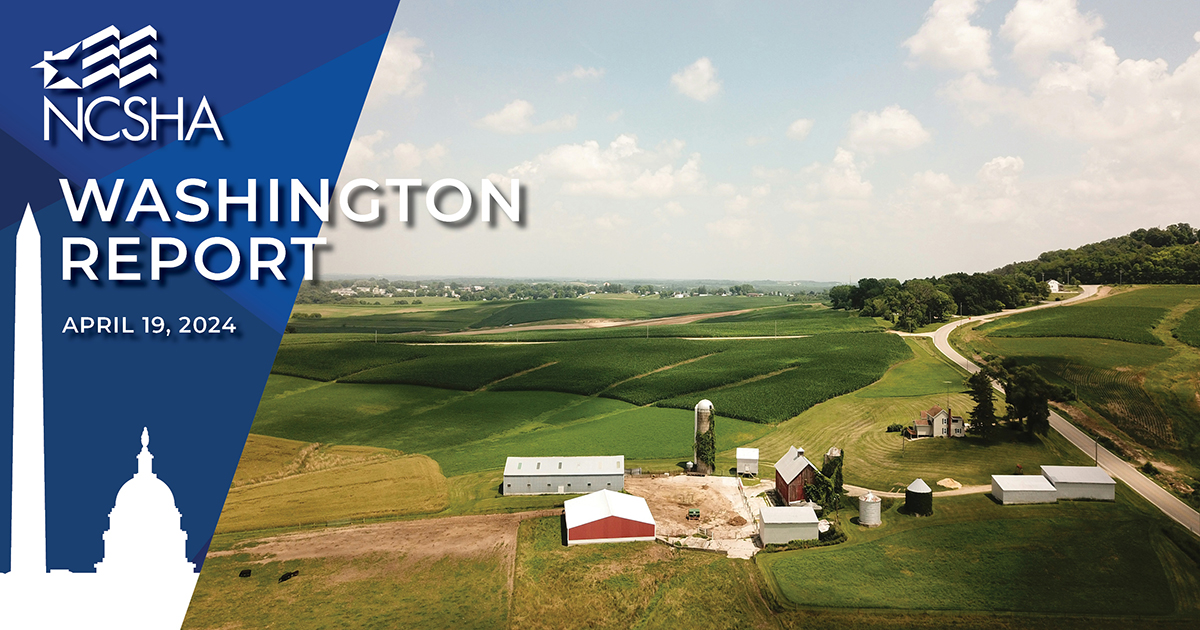
This week’s Senate hearing focused on preservation needs in rural communities today. Nearly 90 percent of rural counties in the U.S. have rental housing financed by the USDA, but much of it is in poor condition and more of it continues to fall out of the “assisted affordable” inventory every year.
For instance, more than 150,000 apartments financed by the department’s Section 515 program have been lost over the past 10 years, and the cost to keep the 390,000 remaining units affordable and in good condition is at least $30 billion, according to the Housing Assistance Council. No new Section 515 apartments have been built for more than a decade.
USDA’s FY 2024 budget includes a small pilot program that will support preservation of Section 515 properties with “expiring” financing through standalone Section 521 project-based rental assistance contracts. The Rural Housing Service Reform Act, a bipartisan bill introduced by Senator Smith (D-MN, who chaired the hearing) and Senator Rounds (R-SD) would expand the pilot and make a number of other improvements.
Another bipartisan rural housing priority in the Senate (and the House) is resolving an ambiguity in the way federal tax law relates to Fannie Mae and Freddie Mac’s ability to invest efficiently in Housing Credit-supported preservation and new construction, which NCSHA began raising in 2022. Senators Warner (D-VA) and Moran (R-KS) and 18 of their colleagues are pressing the Treasury Department for a solution.
The Senate hearing didn’t only highlight areas of common ground on rural rental housing: It broadened the preservation frame to include owner-occupied homes. That’s huge because more than half of rural residents dealing with a federally defined housing “cost burden” own their homes. A new analysis by Lending Tree finds that, of the 7.4 million U.S. households living in poverty, 41 percent are homeowners and “impoverished families are more likely to be homeowners in more rural parts of the country.”
Wyoming Community Development Authority Deputy Executive Director Christopher Volzke, who testified at the hearing, pointed out almost one-third of the housing stock in his state is more than 50 years old, and local communities typically lack resources to help owners remain where they have deep roots (an issue that “hits home” for him as a fifth-generation member of a ranching and farming family).
Wyoming Senator Lummis (R) pointed to her co-sponsorship of a home repair bill with Senator Fetterman (D-PA) as yet another example of bipartisan cooperation and suggested the time is now for a comprehensive housing bill both parties can support and the Senate should pass sooner than later.
We couldn’t agree more.

Stockton Williams | Executive Director
In This Issue
- Wyoming CDA Testifies at Senate Hearing on Affordable Housing Preservation
- NCSHA Recommends HUD Delay Build America Implementation, Broadly Exercise Waiver Authority
- NCSHA Submits Comments on Rural Housing Loan Servicing Proposals
- Todman, Thompson Testify at Senate Banking Committee Hearing
- HUD Increases FHA Multifamily Insurance Policy Deductible
- Freddie Mac Proposes Purchase of Single-Family Closed-End Second Mortgages
- USDA to Hold Symposium on Multifamily Loan and Rental Assistance Decoupling
- FHFA Sets Date for FHLB – CDFI Symposium
- Mission Report Summarizes GSE Affordable Housing Activities in 2023
- NCSHA in the News
- Looking Ahead
Wyoming CDA Testifies at Senate Hearing on Affordable Housing Preservation
Christopher Volzke, deputy executive director of the Wyoming Community Development Authority, testified Tuesday during a Senate Banking Subcommittee on Housing, Transportation, and Community Development hearing on preserving the nation’s affordable housing. In his testimony, Volzke touted several NCSHA legislative priorities for increasing housing supply, including the HOME Reauthorization and Improvement Act, Affordable Housing Credit Improvement Act, Affordable Housing Bond Enhancement Act, and Neighborhood Homes Investment Act. At the end of the hearing, Subcommittee Chair Tina Smith (D-MN) and Ranking Member Cynthia Lummis (R-WY) both expressed hope they could develop bipartisan legislation to help preserve affordable housing. In addition to Volzke, the subcommittee heard from Jesse Ergott of NeighborWorks Northeastern Pennsylvania and Robin Davey Wolff of Enterprise Community Partners.
NCSHA Recommends HUD Delay Build America Implementation, Broadly Exercise Waiver Authority
On Monday, in response to a request for information issued by the U.S. Department of Housing and Urban Development (HUD) regarding new Buy America, Build America (BABA) domestic sourcing requirements scheduled to go into effect for the HOME and Housing Trust Fund programs in August, NCSHA submitted comments requesting HUD delay its implementation of these requirements for at least one year. NCSHA noted the potential impact the requirements could have on the cost and feasibility of certain affordable housing developments, given the difficulty some developers may have in procuring necessary products from domestic sources.
NCSHA Submits Comments on Rural Housing Loan Servicing Proposals
Last week, NCSHA submitted comments to the U.S. Department of Agriculture’s Rural Development (RD) office on proposed changes to its loan servicing policies and procedures contained in Handbook 1-3555. In March, RD announced it was soliciting stakeholder input on the proposed policy revisions before they go into effect. NCSHA’s letter requests, among other things, that RD policy clearly exempt mortgages funded by tax-exempt Mortgage Revenue Bond programs from certain of its proposed requirements, for example, the up-to-480-month loan modification.
Todman, Thompson Testify at Senate Banking Committee Hearing
Acting HUD Secretary Adrianne Todman and Federal Housing Finance Agency (FHFA) Director Sandra L. Thompson appeared before the Senate Banking Committee during a hearing held yesterday. In his opening statement, Committee Chair Sherrod Brown (D-OH) praised recent actions taken by HUD and FHFA to support affordable housing, including HUD’s decision to extend indefinitely Federal Financing Bank financing of FHA – HFA Risk-Sharing program loans, but said much more needed to be done to address the nation’s affordable housing crisis. Ranking Member Tim Scott (R-SC) agreed with Brown about the need for Congress to support housing but argued spending by the Biden Administration and unnecessary regulations are contributing to housing costs. In their statements, both Todman and Thompson reiterated their agencies’ commitments to meeting their affordable housing missions and building a more equitable housing finance system.
HUD Increases FHA Multifamily Insurance Policy Deductible
HUD published Wednesday a mortgagee letter increasing the maximum casualty insurance deductible amount for wind and named storm coverage for Federal Housing Administration-insured multifamily properties to the greater of $50,000 or five percent of the insurable value per location, up to a maximum of $475,000 per occurrence. Of note, the new deductible limits apply only to new mortgage insurance transactions. This change comes as multifamily properties in many parts of the country are being affected by increasing insurance costs.
Freddie Mac Proposes Purchase of Single-Family Closed-End Second Mortgages
On Tuesday, FHFA released a draft notice seeking public comments on a new product proposal by Freddie Mac to purchase certain single-family closed-end second mortgages. Under the proposal, an eligible loan would be a fixed-rate, fully amortizing loan up to a 20-year term on the borrower’s primary residence, and Freddie Mac would purchase a second mortgage only if it currently owns the first mortgage. FHFA Director Sandra L. Thompson said, “The proposed activity is intended to provide homeowners with a cost-effective alternative for accessing the equity in their homes.” Comments on the proposal will be due 30 days after the notice’s publication in the Federal Register. Please email any feedback to Rosemarie Sabatino by May 10 to inform NCSHA’s comments.
USDA to Hold Symposium on Multifamily Loan and Rental Assistance Decoupling
The U.S. Department of Agriculture announced Tuesday it will host an industry call on April 25 at 2:00 pm Eastern to discuss the rental assistance decoupling authority Congress established in USDA’s Fiscal Year 2024 appropriations bill. Currently, when a Section 514 or 515 mortgage matures, units within that property are no longer eligible to receive USDA’s rental assistance. The legislation authorizes USDA to establish a pilot program to allow borrowers with maturing Section 514 or 515 mortgages to decouple their rental assistance. Up to 1,000 units could participate in the pilot, ensuring those residents continue to receive rental aid. USDA said it is developing a notice to owners of maturing mortgages that will outline eligibility requirements, rent-setting structure, and terms of the new rental contract.
FHFA Sets Date for FHLB – CDFI Symposium
FHFA announced Tuesday it will host a Federal Home Loan Bank (FHLB) and Community Development Financial Institution (CDFI) Symposium in Washington, DC, on June 20. The symposium is intended to carry out a recommendation included in FHFA’s “FHLBank System at 100: Focusing on the Future” report calling for increased FHLB engagement with CDFIs and other mission-oriented members. Those interested in attending can register here. NCSHA staff will attend and consider opportunities for FHLBs to work more closely with HFAs.
Mission Report Summarizes GSE Affordable Housing Activities in 2023
On Wednesday, FHFA released its latest mission report outlining the affordable housing activities undertaken by the government-sponsored enterprises (GSEs) Fannie Mae and Freddie Mac and the Federal Home Loan Banks in 2023. According to the report, the GSEs purchased more than 136,000 single-family mortgages for low- and moderate-income households through their core homeownership products, as well as more than 15,000 mortgages originated through special purpose credit programs. Among their multifamily activities, the GSEs purchased nearly $81 billion in affordable multifamily housing loans to support the construction of nearly 700,000 units and made a total of $1.7 billion in Housing Credit investments last year. The FHLBs provided almost $447 million under their affordable housing programs (AHPs) in 2023, supporting more than 33,000 units for low- and moderate-income households. Housing Credit projects received nearly 43 percent of all AHP funding distributed last year.
NCSHA in the News
NonDoc, 4.12.24, Deborah Jenkins: Oklahoma Housing Finance Agency focused on rising housing needs
Legislative and Regulatory Activities
- April 25 | Stakeholder Session: USDA Decoupling Program Development | Virtual
- May 10 | Comments Due to NCSHA | Freddie Mac Proposed Purchase of Single-Family Closed-End Second Mortgages
- May 28 | Stakeholder Listening Session: Proposed Modifications to HUD’s Project-Based Rental Assistance Contract Administration Program | Washington, DC, and Virtual
- June 20 | FHFA FHLBank and CDFI Symposium | Washington, DC, and Virtual
NCSHA, State HFA, and Industry Events
- April 30 – May 2 | 2024 Affordable Housing Investors Council Spring Meeting | Milwaukee, WI
Garth Rieman will speak at this event. - May 1, 11:59 pm ET | Entry Deadline | NCSHA’s 2024 Awards for Program Excellence
- May 1 – 2 | Pennsylvania Housing Finance Agency’s 2024 Housing Forum | Harrisburg, PA
Jennifer Schwartz will speak at this event. - May 1 – 4 | National Association of Local Housing Finance Agencies’ 2024 Annual Conference | Las Vegas, NV
Robert Henson will speak at this event. - May 13 | Early-Bird Discounts End | NCSHA’s Housing Credit Connect & Marketplace | Atlanta
- June 10 – 13 | NCSHA’s Housing Credit Connect & Marketplace | Atlanta