NCSHA Washington Report | September 29, 2023
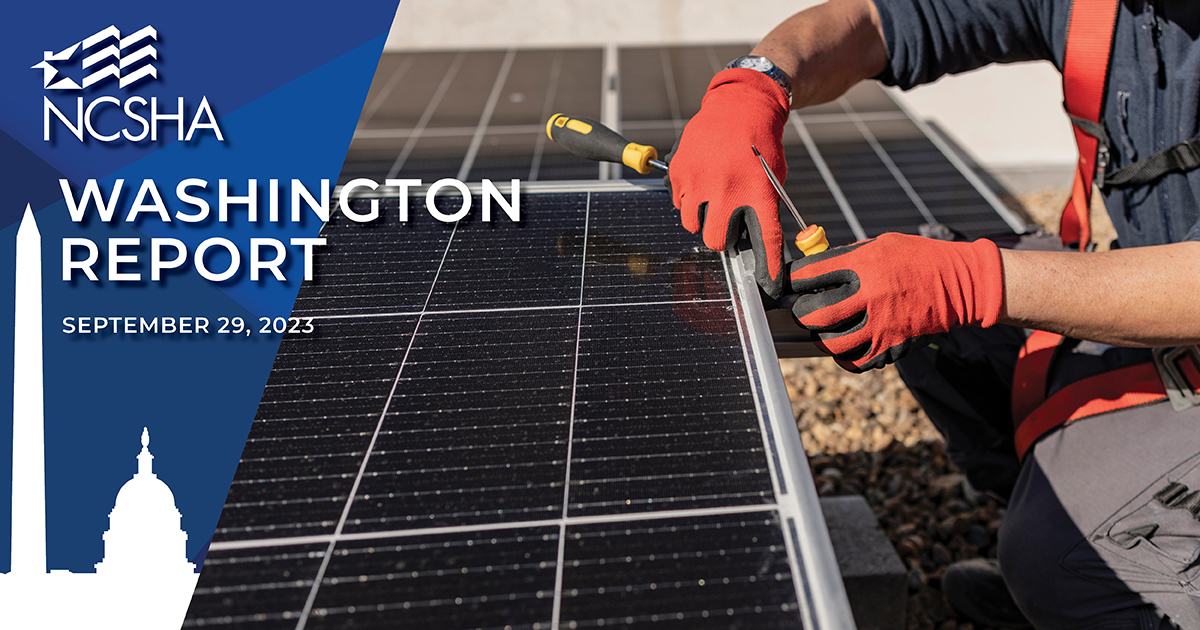
Hundreds of state and local agencies, tribal governments, and nonprofit organizations are scrambling to finish applications due in two weeks to the Environmental Protection Agency for a combined $21 billion through two new programs aimed at accelerating pollution-reducing improvements to America’s built environment.
Housing finance agencies from all parts of the country are working with partners to ensure some of that money makes it into affordable housing. Eight HFAs are leading their state’s application for the $7 billion Solar for All program, and at least that many more are part of multiagency state teams putting in proposals. Similar numbers have joined teams competing for funding from the $14 billion National Clean Investment Fund.
Congress was clear in authorizing both programs that lower-income people and neighborhoods needed to be primary beneficiaries of the unprecedented federal investment. Energy improvements to affordable housing are an obvious environmental equity win-win — all the more when a state HFA can bring its resources and relationships to the table.
In fact, HFAs have long recognized helping homeowners, renters, and landlords save on energy supports their housing affordability mission and have made that happen through a number of different programs, policies, and products.
For example, 16 HFAs administer the federal Weatherization Assistance Program (WAP), which mostly funds single-family home energy upgrades, while 21 agencies require or incentivize higher-than-standard energy performance in the multifamily properties they support with financing and Housing Credits. In addition, 22 HFAs administer a specialized energy-efficiency subsidy or financing program, serving either or both owner-occupied and rental properties in their states.
The scope of HFA innovation and impact on energy is best illustrated in a set of case studies we are releasing today. These detailed profiles, produced for NCSHA by Abt Associates with funding from the Wells Fargo Foundation, illustrate the wide range of HFA activities to reduce energy costs and encourage use of renewable energy in affordable housing.
Individually, each case study describes a results-driven HFA program that is serving as a model and inspiration for other agencies. Collectively, they demonstrate that HFA leadership on energy, like in housing, is coming from every part of the country.
Abt Associates also produced a complementary report on newly authorized federal energy-efficiency and renewable energy programs focused in whole or in part on the housing sector, with ideas on how HFAs and their partners can participate in them.
The Infrastructure Investment and Jobs Act of 2021 provided a one-time appropriation of $3.5 billion (roughly 10 times the usual annual appropriation) for weatherization, while the Inflation Reduction Act of 2022 authorized more than $18 billion in grants and at least $36.5 billion in tax credits for housing-related energy purposes over the next 10 years. EPA officials this week expressed optimism that they would remain able to move the programs forward even in the event of a federal government shutdown.
They may represent the largest new federal investments in lower-income homes and apartments for some time. HFAs will play key roles in ensuring they are well used.

Stockton Williams | Executive Director
State HFA Emergency Housing Assistance
In This Issue
- NCSHA Welcomes New Members
- Federal Government Shutdown Looms as House and Senate Diverge on FY24 Funding
- NCSHA Calls on HUD, USDA to Help Mitigate Housing Credit Qualified Contract Losses
- Treasury Announces New Guidance, Deadlines for New Energy-Related Tax Credits
- HUD and VA Award $16 Million to HFAs, PHAs to Help House Homeless Veterans
- HUD Launches Tool for Finding Energy-Efficiency, Climate-Resilience Resources
- NCSHA in the News
- Looking Ahead
NCSHA Welcomes New Members
These organizations have joined NCSHA as affiliate members in September: Actualize Consulting, LLC; Advantage Capital; California Department of Veterans Affairs; Community Preservation Corporation; Diamond and Associates; Emigrait; Housing Advisory Group; KPMG LLP; Roger Williams University Cummings Institute for Real Estate; and TAM Residential. If you work with a partner interested in becoming a member, please contact Phaedra Stoger.
Federal Government Shutdown Looms as House and Senate Diverge on FY24 Funding
On September 28, the Senate voted 76‒22 to proceed to consider a stop-gap bill to keep the government going from the start of the new fiscal year on October 1 through November 17, but House Republicans quickly rejected the Senate plan, narrowing the path to avert a government shutdown. Earlier today, the House tried but failed to pass its own stop-gap bill, which likely would have been dead on arrival in the Senate. In light of these developments, a shutdown is imminent.
The implications of a shutdown vary by federal agency and program. The Department of Housing and Urban Development (HUD) has indicated in its shutdown contingency plan that previously obligated HOME Investment Partnerships program and Homeless Assistance Grant funds will continue to be available to grantees, and the Federal Housing Administration (FHA) will continue to endorse most forward single-family mortgages. HUD will halt consideration of Green and Resilient Retrofit Program applications, but it appears the Department of Energy and the Environmental Protection Agency will be able to continue implementation of the Greenhouse Gas Reduction Fund and related Inflation Reduction Act programs because they were funded through budget reconciliation instead of a one-year appropriation.
Perhaps more significant than a shutdown for the housing market would be a lapse in the National Flood Insurance Program (NFIP), authority for which also expires on September 30. Under this scenario, existing NFIP policies would remain in place, but no new policies may be issued, or existing policies renewed, potentially hindering many closings where private flood insurance is unavailable. A Senate effort this week to keep the NFIP running on a temporary basis failed because it did not receive the unanimous consent necessary to advance.
NCSHA Calls on HUD, USDA to Help Mitigate Housing Credit Qualified Contract Losses
This week, NCSHA and 13 other Housing Credit stakeholder organizations sent letters to HUD Secretary Marcia Fudge and USDA Secretary Tom Vilsack urging them to take actions to discourage Housing Credit owners from requesting a qualified contract (QC) to terminate the extended use contract on Credit properties that benefit from HUD or USDA programs and insurance. In the letter to Fudge, we encouraged HUD to prohibit FHA from insuring a multifamily loan on a Housing Credit property if the owner has not agreed to waive their QC rights or has already taken the property through the QC process and terminated the rent and income limitations. The letter also asked HUD to prohibit the use of HUD funding, such as HOME program financing for Housing Credit properties, unless the owner agrees to waive their QC rights. In the letter to Vilsack, we urged USDA to prohibit issuing a Section 538 Multifamily Housing Loan Guarantee for a Housing Credit property unless the owner agrees to waive their QC rights or if the owner has already taken a property through the QC process.
Treasury Announces New Guidance, Deadlines for New Energy-Related Tax Credits
The Treasury Department and other federal agencies issued a pair of announcements on September 27 highlighting new tax incentives to promote energy investments in affordable housing and underserved communities. Treasury and the IRS released guidance on the Section 45L energy-efficient home credit, which provides a credit of up to $5,000 for new homes that participate in the Energy Star program and meet certain energy savings requirements, while Treasury, IRS, and the Department of Energy announced the application opening date for the Section 48(e) Low-Income Communities Bonus Credit program, which provides incentives for investment in solar and wind facilities in low-income communities and affordable housing.
HUD and VA Award $16 Million to HFAs, PHAs to Help House Homeless Veterans
Last week, HUD and the Department of Veterans Affairs (VA) announced the 71 housing agencies that will receive more than $16 million in HUD‒VA Supportive Housing (HUD‒VASH) vouchers. These vouchers will enable veterans and their families to find and remain in permanent housing. The program combines HUD rental assistance with management and clinical services provided by the VA. Six HFAs — Alaska Housing Finance Corporation, Michigan State Housing Development Authority, New Hampshire Housing Finance Authority, South Carolina State Housing Finance and Development Authority, Tennessee Housing Development Agency, and Texas Department of Housing and Community Affairs — received a total of nearly $1.1 million in awards. The full list of agencies receiving funding is available here.
HUD Launches Tool for Finding Energy-Efficiency, Climate-Resilience Resources
HUD recently announced the launch of its Funding Navigator, an online tool that allows users to look for energy- and resilience-related funding available under the Inflation Reduction Act and Bipartisan Infrastructure Law. The tool sorts funding resources based on audience, activity, funding type, location, and other filters.
NCSHA in the News
Crain’s Chicago Business, 9.26.23, Mayors press Congress for big expansion of affordable housing tax credits
Legislative and Regulatory Activities
- September 29 | Comments Due | Council on Environmental Quality Proposed Rule on National Environmental Policy Act Implementing Regulations Revisions Phase 2
- September 29 | Comments Due | HUD Proposed Rule on Modernization of Engagement with Mortgagors in Default
- October 2 | Comments Due | EPA Proposed Rule on Reconsideration of the Dust-Lead Hazard Standards and Dust-Lead Post-Abatement Clearance Levels
- October 4 | Comments Due to NCSHA | RHS Proposed Rule to Update Manufactured Housing Provisions
- October 6 | Comments Due to NCSHA |Treasury’s Interim Final Rule to Implement Amendments to the Coronavirus State and Local Fiscal Recovery Funds
- October 12 | Application Deadline EXTENDED | Solar for All Notice of Funding Opportunity
- October 16 | Comment Deadline | RHS Proposed Rule to Update Manufactured Housing Provisions
- October 30 | Application Deadline | Pathways to Removing Obstacles to Housing
NCSHA, State HFA, and Industry Events
- October 4 | Maine Affordable Housing Conference | Portland, ME
Stockton Williams is speaking at this event. - October 14 – 17 | NCSHA’s 2023 Annual Conference & Showplace | Boston
- October 23 – 24 | North Carolina Affordable Housing Conference | Raleigh, NC
Stockton Williams is speaking at this event.
October 24 – 26 | NAHMA Biannual Top Issues in Affordable Housing Fall Conference | Washington, DC
Jennifer Schwartz is speaking at this event.
Back to NCSHA Washington Report
Only members receive NCSHA Blog and Washington Report.