NCSHA Washington Report | May 19, 2023
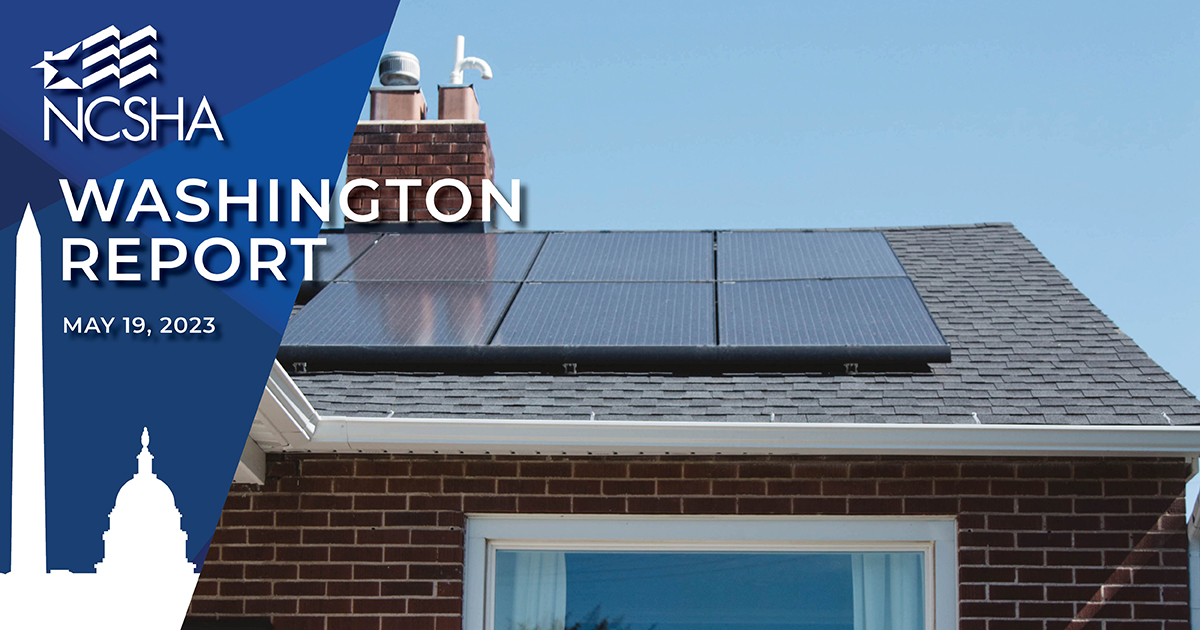
Nine months after the passage of the Inflation Reduction Act, considered by many President Biden’s signature achievement, the mind-boggling scale of the law’s incentives for renewable energy are coming into focus.
The IRA’s two dozen tax breaks (plus a few loan programs) could generate $3 trillion in activity over the next 10 years, “more than two times the total investment in the U.S. shale revolution” according to Goldman Sachs. The research group Climate Power said 191 projects representing $243 billion in investment were announced by the end of March.
IRA-funded projects are being proposed at an unprecedented size too, sparking community opposition in some areas, The Wall Street Journal reported last week: “Even in states with a long history of building renewables, developers don’t know if they can get local permits or how long it might take.” (Improvements to energy permitting processes at the federal level are in the mix in the debt ceiling negotiations.)
Several IRA tax incentives envision affordable housing benefitting from the renewable energy transformation the law aims to catalyze, mainly in the form of rooftop solar installations in multifamily developments. “The magnitude of the added benefits means that every developer and owner should consider adding solar to their LIHTC properties, both those in service and those under development,” argues Mike Novogradac, whose firm has produced several detailed analyses.
In February, the Treasury Department released regulatory guidance for the IRA’s Low-Income Communities Bonus Credit, which provides a 20 percent boost to the investment tax credit for solar and wind energy projects in eligible areas. Politico reported some advocates for affordable solar felt the Treasury rules “largely ignored recommendations developed through a collaboration of renewable energy, environmental, affordable housing and racial justice advocates that was designed to build on lessons learned from state-level programs.”
Additional guidance from Treasury expected by late summer on how developers and others can apply for the bonus credit, which is capped in terms of the amount of solar power eligible for subsidy, may address the concerns.
The IRA also authorized $27 billion to “provide competitive grants to mobilize financing and leverage private capital for clean energy and climate projects that reduce greenhouse gas emissions with an emphasis on projects that benefit low-income and disadvantaged communities” through a new program called the Greenhouse Gas Reduction Fund, run by the Environmental Protection Agency.
EPA has said it sees state HFAs as the kind of “community lenders” that could play a role in delivering fund resources to retrofit affordable multifamily properties, as NCSHA had recommended. The agency plans to open grant competitions for the funds this summer and intends to award $20 billion of the funds to only 4 – 10 nonprofit organizations. We hope the agency will reconsider that approach.
Opening the door to apply to more organizations would reduce the risk some parts of the country will be left out and stands to better fulfill the IRA’s ambition to “revitalize communities that are marginalized, underserved, and overburdened by pollution while increas[ing] access to affordable and accessible clean energy.”
Stockton Williams | Executive Director
Washington Report will return June 2.

Stockton Williams | Executive Director
State HFA Emergency Housing Assistance
In This Issue
- NCSHA Comments on EPA GGRF Framework
- NCSHA Recommends Changes to FHFA Capital Framework
- NCSHA Responds to FHFA Social Bond RFI
- House Appropriations Agriculture Subcommittee Marks Up FY24 Rural Housing Funding Bill
- HUD Issues 2023 Income Limits for Multiple Programs
- House Housing Subcommittee Discusses FHFA LLPA Pricing
- FHFA Issues RFI on GSE Pricing for Single-Family Loans
- Looking Ahead
NCSHA Comments on EPA GGRF Framework
On May 12, NCSHA submitted comments to the Environmental Protection Agency supporting elements of its Implementation Framework for the Greenhouse Gas Reduction Fund (GGRF) that support using GGRF resources for affordable housing and encourage providing funding through housing finance agencies. NCSHA’s letter recommended EPA provide grants to more intermediaries under the GGRF National Clean Investment Fund and Clean Communities Investment Accelerator, prioritize applications that propose engaging with HFAs and using GGRF for affordable housing, and allow for structuring GGRF as loans to avoid complications when assisting developments also using Housing Credits.
NCSHA Recommends Changes to FHFA Capital Framework
Late last week, NCSHA submitted comments in response to a Federal Housing Finance Agency (FHFA) proposal to modify several provisions of the Enterprise Regulatory Capital Framework (ERCF) for Fannie Mae and Freddie Mac. The ERCF governs how much capital Fannie Mae and Freddie Mac must hold on their books for various assets they hold, including mortgage loans and securities. NCSHA supported a provision in the proposed rule reducing by 40 percent the risk multiplier assigned to multifamily mortgages backed by properties receiving government subsidies, including the Housing Credit, Section 8 project-based rental assistance, and other state and local programs. This adjustment, NCSHA argued, would increase Fannie Mae’s and Freddie Mac’s ability to support affordable housing while posing little risk to the firms’ financial health. NCSHA urged FHFA to consider reducing the risk multiplier for such properties even further and also to apply it to properties receiving funding through the HOME Investment Partnerships program and from tax-exempt multifamily housing bonds. The letter also expresses support for FHFA’s proposals to reduce the risk weighting for commingled mortgage-backed securities that contain loans guaranteed by both Fannie Mae and Freddie Mac and to change how the firms determine a home buyer’s representative credit score for the purposes of the ERCF.
NCSHA Responds to FHFA Social Bond RFI
NCSHA on Wednesday sent a letter to FHFA responding to its Request for Input on Fannie Mae and Freddie Mac’s policies toward social bonds. In the letter, NCSHA argued that the Government Sponsored Enterprises (GSEs) issuing single-family mortgage securities that are classified as social bonds under the framework for Environmental, Social, and Governance (ESG) securities could help to increase liquidity in the single-family market and expand access to affordable homeownership loans for working families and other underserved communities. NCSHA urged FHFA to work with the GSEs to explore issuing single-family ESG bonds and suggested HFAs would be ideal partners for the GSEs to work with as they develop and expand ESG programs.
House Appropriations Agriculture Subcommittee Marks Up FY24 Rural Housing Funding Bill
The House Appropriations Agriculture Subcommittee met on Thursday to mark up the House’s FY24 Agriculture, Rural Development, Food and Drug Administration, and Related Agencies bill. The legislation would allocate $17.163 billion for programs under the subcommittee’s jurisdiction, more than $8 billion less than the FY23 enacted level. Subcommittee Chair Andy Harris (R-MD) said the bill reflected what many Americans are having to do on a daily basis: accomplish more with less. Harris believes the bill is a step in the right direction to correct overspending during the pandemic. Appropriations Committee Ranking Member Rosa DeLauro (D-CT) called the bill a “sham” and said the legislation would return the Department of Agriculture’s funding to levels not seen since 2006. The bill would provide $900 million for the Section 502 Single-Family Direct Loan program, a 28 percent decrease from FY23 enacted levels. Section 502 Single-Family Guaranteed Loans would receive level funding, at $30 billion. The Section 515 Multifamily Direct Loan program would be appropriated $60 million, 14 percent less than FY23. The Section 521 Rental Assistance program would receive an increase of eight percent for a total of $1.61 billion. The Section 538 Multifamily Guaranteed Loan and Section 542 Rental Voucher Assistance programs would receive the same funding as FY23, $400 million and $48 million, respectively. The rental preservation demonstration program (MPR) would receive $34 million, a six percent decrease from FY23. No amendments were submitted during the mark-up, and the bill was favorably reported, by voice vote, to the full Appropriations Committee.
HUD Issues 2023 Income Limits for Multiple Programs
On May 15, the Department of Housing and Urban Development (HUD) issued 2023 income limits to determine eligibility for various HUD housing programs, including the public housing, Section 8 project-based, Section 8 Housing Choice Voucher, Section 202 Housing for the Elderly, and Section 811 Housing for Persons with Disabilities programs. HUD issued separate Multifamily Tax Subsidy Project income limits, used to determine eligibility for Housing Credit and tax-exempt housing bonds, and Homeowner Assistance Fund income limits the same day. These income limits are effective immediately. On May 18, HUD issued separate HOME income limits with an effective date of June 15.
House Housing Subcommittee Discusses FHFA LLPA Pricing
The House Housing and Insurance Subcommittee on Wednesday afternoon held a hearing to discuss changes to the pricing framework for Fannie Mae and Freddie Mac’s guarantee fees for single-family mortgages announced by FHFA in January. Subcommittee Chair Warren Davidson (R-OH) criticized the new pricing framework, which he said would increase the cost of buying a home for responsible borrowers with higher credit scores through higher guarantee fees. He said he hoped Congress would pass legislation, a discussion draft of which was released recently, to rescind the fees, prevent FHFA from setting loan-level price adjustments (LLPAs) based on a borrower’s debt-to-income (DTI) ratio, and require a study from the Government Accountability Office before FHFA considers any changes to the pricing framework. Ranking Member Emmanuel Cleaver (D-MO) contended the reaction to the pricing changes has been overblown and noted home buyers with higher credit scores and DTI ratios still pay considerably lower fees on GSE mortgages than other borrowers. Cleaver also noted many civil rights groups have long urged FHFA to rescind the LLPAs because they make homeownership less affordable for many households of color.
The House Financial Services Committee likely will continue its discussion of these issues when it holds a hearing May 23 with FHFA Director Sandra L. Thompson on FHFA Oversight: Protecting Homeowners and Taxpayers.
FHFA Issues RFI on GSE Pricing for Single-Family Loans
On Monday, FHFA released a Request for Input (RFI) on the pricing framework Fannie Mae and Freddie Mac use to determine guarantee fees on the single-family mortgages they guarantee. The RFI seeks input on what goals and priorities the agency should pursue when overseeing the framework. FHFA also specifically asks about the process for establishing the upfront guarantee fees the GSEs charge and whether such fees should be linked to the Enterprise Regulatory Capital Framework. As noted above, in January, FHFA announced changes to the pricing framework which have been opposed by some members of Congress and industry stakeholders who argue the changes will unfairly raise fees for responsible home buyers with high credit scores and larger down payments. The deadline to reply to the RFI is August 14. NCSHA is likely to submit comments on behalf of all HFAs. Please email Greg Zagorski by August 1 with any input NCSHA should consider.
Legislative and Regulatory Activities
- May 23 | House Financial Services Committee Hearing on FHFA Oversight: Protecting Homeowners and Taxpayers
- May 23, 2 pm ET | HUD Webinar on Green and Resilient Retrofit Program
- May 26 | Comments Due to NCSHA | FHFA Proposed Rule on Fair Lending, Fair Housing, and Equitable Housing Finance Plans
- May 31 | Comments Due to NCSHA | Treasury/IRS Priority Guidance Plan
- June 5 | Comments Due to NCSHA | IRS MRB and MCC Purchase Price Limits and Safe Harbors Revenue Procedure
- June 9 | Comments Due | Treasury/IRS Priority Guidance Plan
- June 19 | Comments Due | IRS MRB and MCC Purchase Price Limits and Safe Harbors Revenue Procedure
- June 26 | Comments Due | FHFA Proposed Rule on Fair Lending, Fair Housing, and Equitable Housing Finance Plans
- June 30 | Comments Due to NCSHA | Notice of Preliminary Determination on Adoption of Energy Efficiency Standards for New Construction of HUD- and USDA-Financed Housing
- TBD | Comments Due | Notice of Preliminary Determination on Adoption of Energy Efficiency Standards for New Construction of HUD- and USDA-Financed Housing
NCSHA, State HFA, and Industry Events
- May 30 | BWE Affordable Housing Policy Update: Debt Ceiling and AHCIA Impacts on Affordable Housing | Virtual
Jennifer Schwartz will speak at this event. - May 31 | Early-Bird Registration Ends | Louisana Housing Conference | Baton Rouge, LA
- May 31 – June 1 I Fannie Mae Affordable Lending Summit | Washington, DC
Stockton Williams will speak at this event. - June 7 | HCCP Board of Governors Average Income Test Webinar | Virtual
Jennifer Schwartz will speak at this event. - June 13 – 16 | NCSHA’s Housing Credit Connect & Marketplace | Seattle, WA
Back to NCSHA Washington Report
Only members receive NCSHA Blog and Washington Report.