NCSHA Washington Report | May 12, 2023
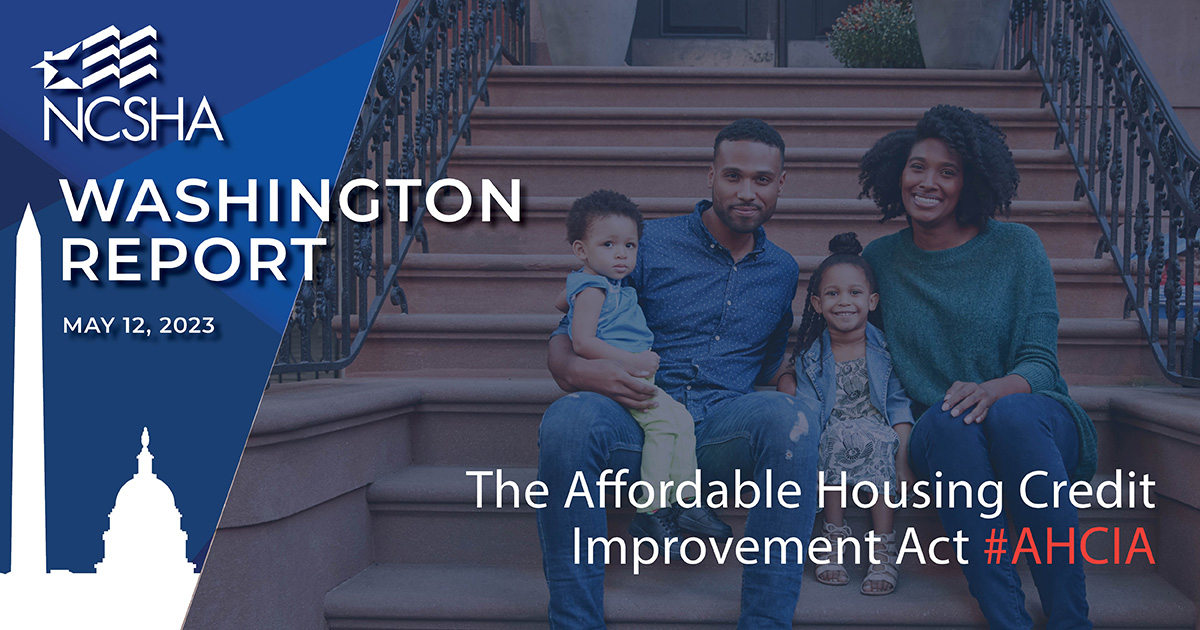
Rarely has a bill in Congress been better made for its moment than the Affordable Housing Credit Improvement Act, introduced yesterday in the House and Senate.
A moment of urgent need for millions of Americans sacrificing on every other essential to pay rent that still consumes half or more of their income. A moment of an historic housing shortage in our country and more challenging conditions to build affordably than ever before. A moment of polarization and partisan rancor in Congress so entrenched that nearly 80 percent of us disapprove of the way it’s handling its job.
The AHCIA meets this moment and its challenges head-on.
The bill addresses directly the root cause of America’s housing affordability crisis — the deficit of affordable rental homes — by investing in the most effective federal policy ever created to produce them: the Housing Credit. It does so at a scale sufficient to make meaningful progress on the problem, promising to produce nearly two million more homes over 10 years. And it comes out of the gate with a depth and breadth of support in both parties almost unheard of for legislation of such significance.
The House version of the AHCIA on day one had more than 60 cosponsors — 15 percent of the entire chamber and two-thirds of its tax-writing Ways and Means Committee — split equally among Republicans and Democrats and including members reflecting the entire ideological spectrum of the Congress. The Senate version of the bill is equally bipartisan among its four lead sponsors, and its co-sponsorship drive starts next week.
Nobody would have predicted the Tax Reform Act of 1986 would enact the most successful federal affordable housing program in history. Few believed the credit could be significantly expanded to catch up to housing needs that had accrued during its first 15 years, until it was, on the last day of the 106th Congress, in December 2000. Conventional wisdom says legislative proposals like AHCIA depend on big tax cut bills to advance — but the credit has been augmented most recently in regular government funding bills.
The Housing Credit, its champions in Congress, and its unified and energized advocacy coalition representing the entire affordable housing community have a history of making history. It’s time to make some more.
Stockton Williams | Executive Director

Stockton Williams | Executive Director
State HFA Emergency Housing Assistance
In This Issue
- Affordable Housing Credit Improvement Act Introduced in Congress
- HUD Posts Green and Resilient Retrofit Program Notice, NOFOs
- HUD Issues NSPIRE Model Final Rule for Physical Inspections
- Treasury Updates Emergency Rental Assistance Guidance to Reflect Public Health Emergency’s End
- FHFA Rescinds New Fees for Higher DTI Loans
- White House Announces Adoption of Latest Energy Codes
- Shaheen, Smith Introduce Rural Preservation Bill
- NCSHA in the News
- Looking Ahead
Affordable Housing Credit Improvement Act Introduced in Congress
On May 11, Housing Credit champions in both chambers of Congress reintroduced the Affordable Housing Credit Improvement Act (AHCIA; S. 1557/H.R. 3238), one of NCSHA’s top legislative priorities. Sponsored by Senators Maria Cantwell (D-WA), Todd Young (R-IN), Ron Wyden (D-OR), and Marsha Blackburn (R-TN) and House members Darin LaHood (R-IL), Suzan DelBene (D-WA), Brad Wenstrup (R-OH), Don Beyer (D-VA), Claudia Tenney (R-NY), and Jimmy Panetta (D-CA), the bill would expand and strengthen the Housing Credit program. The House bill already has more than 60 bipartisan original cosponsors — 15 percent of the House — while Senate champions introduced the bill with the primary four leads as the original cosponsors and are now seeking more Senators to join as cosponsors. You can be part of this advocacy effort by joining the ACTION Campaign. For more information about the bill, see NCSHA’s blog or check out the one-page bill summary and detailed section-by-section summary.
HUD Posts Green and Resilient Retrofit Program Notice, NOFOs
The Department of Housing and Urban Development (HUD) published Thursday an implementation notice and additional materials, including Notices of Funding Opportunity (NOFOs), a program overview, and frequently asked questions related to its Green and Resilient Retrofit Program (GRRP). GRRP provides owners of HUD-assisted multifamily housing up to $837.5 million in grant funding and $4 billion in loan authority to reduce carbon emissions, make utility efficiency improvements, incorporate renewable energy sources, and make properties more climate hazard-resilient. The program’s NOFOs and notice detail multiple grant and loan funding options, which are designed to meet the needs of applicants with varying levels of expertise with green retrofits. HUD will hold a webinar on GRRP on May 23 at 2 pm ET (register here). HUD also will offer office hours to respond to questions every Wednesday between May 24 and June 28 from 3 – 4 pm ET at https://zoom.us/j/99199273258; no registration is necessary.
HUD Issues NSPIRE Model Final Rule for Physical Inspections
On May 11, HUD published the final rule for the National Standards for the Physical Inspection of Real Estate (NSPIRE), which sets forth a new approach to ensuring HUD-financed housing meets quality standards and aligns and consolidates inspection regulations across multiple HUD programs. NSPIRE replaces Housing Quality Standards and Uniform Physical Condition Standards, which had previously been used for purposes of physical inspections of HUD programs.
NSPIRE will apply to public housing inspections beginning July 1 and to the Housing Choice Voucher, Project-Based Voucher, Section 8 Moderate Rehabilitation, HOME Investment Partnerships (HOME), Housing Trust Fund (HTF), Housing Opportunities for Persons with AIDS (HOPWA), Emergency Solutions Grant (ESG), and Continuum of Care (CoC) programs October 1. Prior to the final rule’s publication, the Internal Revenue Service indicated to NCSHA it plans to consider whether to apply NSPIRE to the Housing Credit after HUD publishes the final rule.
HUD will provide its grantees additional transition information in three core “Subordinate Notices” to come: the NSPIRE Standards Notice, the NSPIRE Scoring Notice, and the NSPIRE Administrative Notice. HUD’s Office of Community Planning and Development will issue additional NSPIRE guidance for the HOME, HTF, ESG, HOPWA, and CoC programs. Other HUD offices will similarly publish further guidance for specific programs.
Treasury Updates Emergency Rental Assistance Guidance to Reflect Public Health Emergency’s End
On May 10, Treasury updated its Frequently Asked Questions (FAQs) on Emergency Rental Assistance (ERA) to address the May 11 end of the Covid-19 public health emergency declaration. The change to the document was needed to continue to allow grantees to permit ERA applicants to rely on self-attestation of household income without additional documents. The earlier version of the FAQs stated that policies permitting self-attestation alone were allowable during the public health emergency. The updated FAQs provide that a grantee may continue to permit the use of self-attestation alone as long as the grantee’s policies and procedures permitted the use of self-attestation alone as of May 11, 2023.
FHFA Rescinds New Fees for Higher DTI Loans
The Federal Housing Finance Agency (FHFA) Wednesday announced it was rescinding new loan-level price adjustments (LLPA) based on a borrower’s debt-to-income (DTI) ratio for loans guaranteed by Fannie Mae and Freddie Mac. The new up-front LLPAs, which were set to take effect on August 1, would have charged a higher fee for all home buyers with a DTI ratio above 40 percent. FHFA said it is rescinding the fees in response to industry feedback. The DTI ratio-based fee was one of several changes to Fannie Mae’s and Freddie Mac’s pricing grids that FHFA first announced in January. The agency now intends to introduce a Request for Input on the firms’ single-family pricing frameworks. The agency says more information on the RFI should be available shortly.
White House Announces Adoption of Latest Energy Codes
The White House announced Thursday that HUD, the Federal Housing Administration, and the U.S. Department of Agriculture (USDA) propose to adopt the latest energy codes to improve the performance and efficiency of new homes and help homeowners and renters save money, pursuant to a Notice of Preliminary Determination due for publication in the Federal Register soon. HUD estimates families will save more than 35 percent on energy costs by building homes using the latest energy codes. Energy efficiency, electrification, and clean energy will make energy costs a smaller fraction of household expenses. This action is related to President Biden’s National Initiative to Advance Building Codes, which supports modern building codes and standards that save lives, reduce property damage, and cut utility bills. Comments are due 60 days after Federal Register publication. To help inform NCSHA’s comments, please send Garth Rieman your input by June 30.
Shaheen, Smith Introduce Rural Preservation Bill
Senators Jeanne Shaheen (D-NH) and Tina Smith (D-MN) this week reintroduced the Strategy and Investment in Rural Housing Preservation Act. The bill was first introduced in the Senate last September and is similar to the Rural Housing Service Reform Act of 2023 — which was the subject of a Senate subcommittee hearing last week — with both seeking to address affordable rural housing shortages by amending current USDA Rural Housing Service programs. The Shaheen/Smith bill would “decouple” Section 521 rental assistance from Section 515 mortgages, allowing residents living in a property with an expiring/expired Section 515 mortgage to retain their rental assistance. The bill would also permanently authorize the Rental Preservation Demonstration program, allow USDA to enter into 20-year rental assistance contracts in properties with existing affordability requirements, provide $50 million for USDA multifamily information technology upgrades, and require USDA to create a plan for affordable rural housing preservation and establish an advisory committee to assist with implementing that plan. The legislation had not received a bill number at the time of writing. More information about the bill is available here.
NCSHA in the News
The Times-Union, 5.5.23, Tax-credit approval given for Crane Street project
Legislative and Regulatory Activities
- May 12 | Comments Due | EPA Implementation Framework for the Greenhouse Gas Reduction Fund
- May 12 | Comments Due | Proposed Changes to GSE Capital Requirements
- May 17 | Comments Due | FHFA RFI on Enterprise Single-Family Social Bond Program
- May 17 | House Subcommittee on Housing and Insurance Hearing | The Current Mortgage Market: Undermining Housing Affordability with Politics
- May 23, 2 pm ET | HUD Webinar on Green and Resilient Retrofit Program
- May 26 | Comments Due to NCSHA | FHFA Proposed Rule on Fair Lending, Fair Housing, and Equitable Housing Finance Plans
- May 31 | Comments Due to NCSHA | Treasury/IRS Priority Guidance Plan
- June 5 | Comments Due to NCSHA | IRS MRB and MCC Purchase Price Limits and Safe Harbors Revenue Procedure
- June 9 | Comments Due | Treasury/IRS Priority Guidance Plan
- June 19 | Comments Due | IRS MRB and MCC Purchase Price Limits and Safe Harbors Revenue Procedure
- June 26 | Comments Due | FHFA Proposed Rule on Fair Lending, Fair Housing, and Equitable Housing Finance Plans
- June 30 | Comments Due to NCSHA | Notice of Preliminary Determination on Adoption of Energy Efficiency Standards for New Construction of HUD- and USDA-Financed Housing
- TBD | Comments Due | Notice of Preliminary Determination on Adoption of Energy Efficiency Standards for New Construction of HUD- and USDA-Financed Housing
- July 7 | Comments Due to NCSHA | CFPB Proposed Rule on R-PACE Loans
- July 24 | Comments Due | HUD Advance Notice of Proposed Rulemaking on Section 504
- July 26 | Comments Due | CFPB Proposed Rule on R-PACE Loans
NCSHA, State HFA, and Industry Events
- May 15 | Last Day for Discounted Early Registration, Hotel Group Rate: NCSHA’s Housing Credit Connect & Marketplace | Seattle, WA
- May 31 | Early-Bird Registration Ends | Louisana Housing Conference | Baton Rouge, LA
- May 31 – June 1 I Fannie Mae Affordable Lending Summit | Washington, DC
Stockton Williams will speak at this event. - June 7 | HCCP Board of Governors Average Income Test Webinar | Virtual
Jennifer Schwartz will speak at this event. - June 13 – 16 | NCSHA’s Housing Credit Connect & Marketplace | Seattle, WA
- July 24 – 26 | Texas Affiliation of Affordable Housing Providers 2023 Texas Housing Conference | Austin, TX
Jennifer Schwartz will speak at this event.
Back to NCSHA Washington Report
Only members receive NCSHA Blog and Washington Report.